Article: How to Clean a Pour Over Coffee Maker: Glass + Stainless Filter Care Guide
How to Clean a Pour Over Coffee Maker: Glass + Stainless Filter Care Guide
Your pour over coffee maker works hard. Every brew, coffee oils coat the carafe and filter. Minerals from your water build up over time. If you don't clean regularly, those oils go rancid and that mineral scale turns what should be a clean, bright cup into something flat and bitter.
The good news is that cleaning a pour over coffee maker with a borosilicate glass carafe and a stainless steel filter is straightforward. This guide covers daily rinses, weekly washes, and the deep clean you should run once a month.
The Two Parts That Need Different Care
Quick answer: The glass carafe and the stainless steel filter each have specific cleaning needs. Glass is easy to clean but shows water spots and oil buildup quickly. The stainless steel filter traps coffee grounds and oils in its mesh weave and needs a periodic vinegar soak to stay fully open.
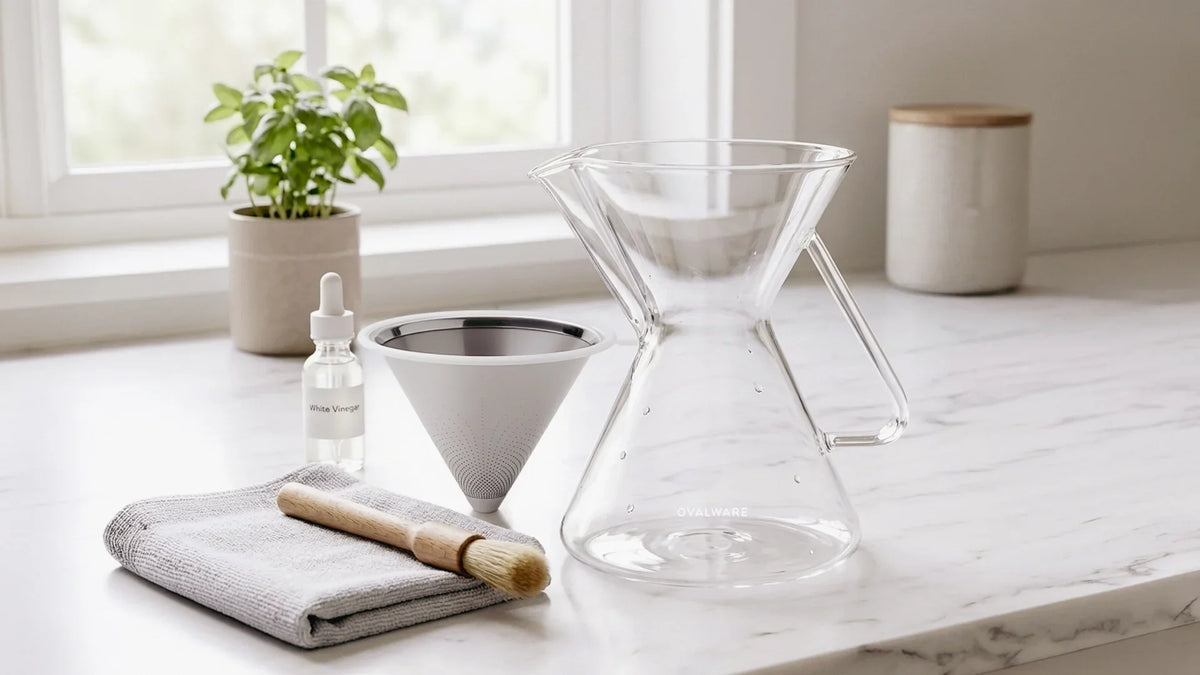
The Ovalware Pour Over Coffee Maker is a 3-piece set: borosilicate glass carafe, dual-layer stainless steel filter, and lid. Both the carafe and filter are dishwasher safe, but hand washing extends their life and keeps the glass spotless. Here's how to care for each one properly.
Daily Care: After Every Brew
Quick answer: Rinse both pieces with warm water immediately after brewing. Dump the grounds from the filter into the trash (not the sink, to avoid clogging). A quick rinse right after use is the most effective maintenance you can do.
- While the carafe is still warm, pour out any remaining coffee.
- Rinse the carafe with warm water. If you see coffee residue on the walls, add a few drops of dish soap, fill halfway with warm water, and swirl. Rinse thoroughly.
- Tap the grounds out of the stainless steel filter into the trash or compost. Don't try to shake them into the sink. They'll clog your drain over time.
- Rinse the filter under warm running water. Use your fingers or a soft brush to rub the mesh gently while rinsing. This dislodges any grounds caught in the weave.
- Let both pieces air dry upside down on a drying rack. Standing water inside the filter breeds mineral deposits and odors.
That's your daily routine. Takes about 90 seconds. Do it every time and you'll rarely need a deep clean.
Weekly Wash: Removing Coffee Oils
Quick answer: Once a week, wash both pieces with dish soap and warm water. Coffee oils are the main culprit behind stale flavors. Soap breaks them down. Don't skip this step even if your brewer looks clean.
Coffee contains natural oils that coat any surface they contact. Over a week of daily brewing, those oils accumulate on the glass walls and inside the mesh filter. Even if you rinse daily, the oils don't fully wash away with water alone.
Washing the Glass Carafe
- Fill the carafe halfway with warm (not hot) water and a drop or two of dish soap
- Use a bottle brush or long-handled sponge to scrub the inside walls in a circular motion
- Pay attention to the bottom where oils pool
- Rinse several times until no soap residue remains. Soap residue affects flavor on the next brew.
- For stubborn dark staining on glass, add 1 tablespoon of baking soda to a cup of warm water and let it sit in the carafe for 10-15 minutes before scrubbing
Washing the Stainless Steel Filter
- Apply a small amount of dish soap to the outside and inside mesh surfaces
- Use a soft brush (a clean toothbrush works well) to scrub both sides of the mesh gently. The dual-layer construction has an outer laser-cut layer and an inner fine mesh. Clean both.
- Rinse thoroughly under running water while continuing to brush. Hold the filter up to the light to check that the mesh is clear. You should see light through it evenly.
- Do not use steel wool or abrasive scrubbers on the mesh. They'll damage the fine inner layer.
Both pieces are dishwasher safe. If you run them in the dishwasher, use the top rack and a gentle cycle. The glass carafe can handle dishwasher heat, but hand washing keeps the glass clearer for longer by avoiding the water spotting that dishwashers leave on glass.
Monthly Deep Clean: Removing Mineral Buildup
Quick answer: Soak both pieces in a 1:1 white vinegar and water solution for 30-60 minutes once a month. This dissolves mineral scale (calcium and magnesium deposits from tap water) that accumulates inside the carafe and clogs the filter mesh over time.
If your tap water is hard, you may need to do this more often. Signs that it's time for a deep clean: water is dripping slower through the filter than usual, the carafe has a white or gray film on the inside walls, or your coffee tastes flat or off even when you haven't changed beans or ratios.
Deep Clean Step-by-Step
- Mix equal parts white vinegar and cold water. You'll need enough to submerge the filter (about 2-3 cups) and fill the carafe partway.
- Pour the vinegar solution into the carafe. Fill to about halfway. Let it sit for 30 minutes.
- Place the filter in a bowl or container with the remaining vinegar solution. Make sure it's fully submerged. Let it soak for 30-60 minutes. For heavily clogged mesh, let it soak for up to 2 hours.
- After soaking, scrub both pieces with a soft brush and then rinse thoroughly under running water. Rinse the carafe at least 3-4 times to make sure no vinegar taste remains.
- Check the filter by holding it up to light again. The mesh should be evenly clear. If you still see clogged spots, repeat the soak.
- Air dry completely before using.
White vinegar is a natural acid that breaks down calcium carbonate and magnesium deposits without damaging borosilicate glass or stainless steel. It's the safest and most effective cleaning solution for both materials.
Avoid bleach. Bleach can pit stainless steel over time and leaves a chemical residue that's very difficult to fully rinse out of the fine mesh weave.
Troubleshooting: Common Problems and Fixes
Quick answer: Slow drip means a clogged filter. Stale or bitter flavor means coffee oil buildup. White residue on glass means mineral scale. Each has a specific fix.
Filter Dripping Too Slowly
This is almost always a clogged mesh. Do the vinegar soak described above. After soaking, use a soft brush to scrub the mesh on both sides under running water. If the problem persists, try a longer soak. A completely blocked filter is rare but can happen if the brewer goes unwashed for several weeks.
Coffee Tastes Stale or Rancid
Rancid coffee flavor is the clearest sign of oil buildup. Do a full dish soap wash of both pieces, then follow with a vinegar soak. Change your grind freshness check: stale grounds (pre-ground coffee sitting for weeks) also cause this flavor, so rule out the beans before blaming the equipment.
White Film Inside the Carafe
That white or gray film is mineral scale. A vinegar soak will dissolve it. Fill the carafe with the vinegar-water solution and let it sit for 30-60 minutes. The film will wipe away easily with a soft cloth after soaking.
Water Spots on the Glass
Water spots are mineral deposits left when water evaporates. They don't affect flavor but they make the glass look dirty. Wipe the outside of the carafe with a damp cloth and a small amount of white vinegar, then buff dry with a microfiber cloth.
Dishwasher or Hand Wash: Which Is Better?
Quick answer: Hand washing is better for long-term clarity of the glass and mesh integrity of the filter. The dishwasher is safe and convenient for both pieces, but it leaves water spots on glass and the high-heat drying cycle can accelerate wear on the fine mesh over years of use.
If you run the dishwasher, always use the top rack for both pieces and choose a gentle cycle when available. Skip the heated dry setting and let both pieces air dry after the cycle.
To learn more about how grind size affects flavor and extraction, see our guide on pour over grind size. Clean equipment is important, but it only improves your brew if the fundamentals are also correct.
The Ovalware Pour Over Coffee Maker
| Feature | Details |
|---|---|
| Capacity | 500ml / 17oz |
| Carafe material | Borosilicate glass |
| Filter | Dual-layer stainless steel (laser-cut + superfine mesh) |
| Dishwasher safe | Yes (both pieces) |
| Paper filters needed | No |
| Price | $46.99 |
The Ovalware Pour Over Coffee Maker includes the glass carafe, stainless steel filter, and lid. No paper filters needed. Free shipping on US orders $65 and over.
Shop the Pour Over Coffee Maker
Frequently Asked Questions
How often should I clean my pour over coffee maker?
Rinse both pieces after every use. Wash with dish soap once a week. Do a vinegar deep clean once a month, or more often if you have hard water. If you follow this schedule, you'll rarely have to deal with stubborn buildup or off flavors.
Can I put my pour over coffee maker in the dishwasher?
Yes. Both the borosilicate glass carafe and the stainless steel filter are dishwasher safe. Use the top rack and a gentle cycle. Hand washing produces clearer glass and is easier on the fine mesh filter over time.
How do I clean the stainless steel filter if it's clogged?
Soak the filter in a 1:1 white vinegar and water solution for 30-60 minutes, then scrub both sides of the mesh with a soft brush under running water. Repeat if needed. Avoid abrasive scrubbers, which can damage the fine inner mesh layer.
What causes coffee to taste bitter after cleaning?
Soap residue is the most common culprit. Rinse the carafe and filter very thoroughly after any soap wash, at least 3-4 full rinses. If the bitterness persists, brew with water only (no coffee) to flush any remaining soap residue from the system.
Can I use baking soda to clean the glass carafe?
Yes. A tablespoon of baking soda dissolved in warm water is effective for removing stubborn coffee staining from glass. Let it sit for 10-15 minutes, then scrub and rinse. Baking soda is safe for borosilicate glass. Don't mix baking soda with vinegar as a cleaning solution; use them separately.