Japanese Iced Coffee: How to Make Iced Pour Over at Home (Flash Brew Guide)
Most iced coffee is just hot coffee poured over ice and left to dilute. Japanese iced coffee , also called flash brew or iced pour over , is different. You brew hot coffee directly onto ice as you pour, which chills it instantly and locks in the bright, complex flavors that heat-brewed coffee is known for but that slow cold brew can miss.
The result is a glass of iced coffee that's crisp, aromatic, and noticeably more flavorful than anything you'll get from an overnight cold brew. And it takes 5 minutes, not 12 hours.
This guide covers the complete method, the right ratios, which beans to use, and how your brewing equipment affects the outcome.
What Is Japanese Iced Coffee?
Japanese iced coffee (also called flash brew or iced pour over) is a method where hot water is poured through ground coffee directly onto ice, chilling the brew instantly as it drips into the cup. Developed and popularized in Japan's third-wave café scene, it's now used by specialty coffee shops worldwide as an alternative to cold brew for iced drinks.
The key distinction from regular iced coffee is the flash-chilling process. When hot coffee hits ice at the right moment, the rapid temperature drop "locks in" volatile aromatic compounds that would otherwise dissipate as the coffee sat and cooled. The result is iced coffee with brighter acidity, cleaner fruit notes, and more complexity than you get from cold brew or room-temperature coffee poured over ice.
A 2019 study by the American Chemical Society found that hot-brewed coffee contains significantly higher concentrations of certain aromatic compounds and beneficial antioxidants compared to cold brew , and flash chilling preserves those while still giving you a cold drink. (Source: Scientific Reports, Niny Rao, Thomas Jefferson University, 2020)
Flash Brew vs Cold Brew: What's the Difference?
Flash brew is hot-brewed coffee that's instantly chilled on ice. Cold brew is coffee steeped in cold water for 12-24 hours. They taste very different: flash brew is brighter and more aromatic, cold brew is smoother and lower in acidity.
Neither is objectively better , they suit different preferences. Here's how they compare:
| Japanese Iced Coffee (Flash Brew) | Cold Brew | |
|---|---|---|
| Brew time | 4-5 minutes | 12-18 hours |
| Flavor profile | Bright, fruity, aromatic, complex | Smooth, mellow, low acidity |
| Acidity | Higher (like hot coffee, just cold) | Lower |
| Best beans | Light to medium roast | Medium to dark roast |
| Equipment | Pour over maker + scale | Cold brew maker + jar |
| Caffeine | Standard (same as hot brew) | Higher per oz (concentrate-style) or similar (ready-to-drink) |
If you love bright, complex, single-origin coffees, flash brew is almost always the better showcase. If you want low acid and easy batch prep, cold brew wins.
The Flash Brew Ratio: How Much Coffee and Ice Do You Need?
The standard flash brew ratio is 1:15 , roughly 1 gram of coffee per 15 grams of total water, split roughly 60% hot water and 40% ice by weight. The ice compensates for dilution as it melts, so your final brew stays properly concentrated.
Here's a practical breakdown for common serving sizes:
| Serving size | Coffee | Hot water | Ice (by weight) |
|---|---|---|---|
| 1 cup (250ml) | 17g | 160ml | 100g |
| Large (350ml) | 23g | 220ml | 130g |
| Full pour over (500ml) | 33g | 300ml | 200g |
These ratios assume most of the ice melts during the brew. If your kitchen is warm or your pour is slow, the ice melts faster , go heavier on ice and lighter on hot water. If you're using large ice cubes that melt slowly, flip it the other way. The goal is: once the ice melts, you end up with properly concentrated coffee, not watery iced coffee.
Adjust to taste. Some prefer 1:14 (stronger), others like 1:16 for a lighter result.
How to Make Japanese Iced Coffee at Home (Step-by-Step)
Flash brew is made exactly like pour over coffee, with one change: ice goes in the carafe first, and you brew directly onto it. The whole process takes 4-5 minutes once your water is hot.
What you need
- Pour over maker with a stainless steel filter
- Kitchen scale (highly recommended , it's the difference between consistent and unpredictable)
- Kettle (gooseneck preferred for control, but any kettle works)
- Freshly ground coffee, medium-fine grind
- Hot water at 200°F / 93°C (just off the boil)
- Ice

Step-by-step instructions
- Weigh your ice and add it to the carafe. Place your pour over carafe on the scale and add the ice (see ratio table above). The ice goes in the carafe, not in a separate glass , you're brewing directly onto it.
- Rinse the filter (skip if using stainless steel). If using a paper filter, rinse it with hot water first to remove the paper taste. With a stainless steel filter, skip this step entirely , no paper taste to worry about.
- Grind your coffee. Medium-fine , think coarser than espresso but finer than drip. Aim for around 17-23g depending on your serving size.
- Bloom the grounds. Start your timer. Pour just enough hot water to saturate all the grounds (about 2x the weight of the coffee). Wait 30-45 seconds. The grounds will puff up and release CO₂ , this is called the bloom and it opens the grounds for more even extraction.
- Pour in slow, steady circles. Begin pouring in a slow spiral from the center outward, keeping the water level consistent in the filter. Don't flood it , let it drain between pours. Total brew time should be 3:00-4:30 minutes.
- Remove the filter, stir gently. Once all water has passed through, remove the filter and give the brew a gentle stir over the ice. This ensures even temperature throughout.
- Serve immediately. Pour into a glass over fresh ice if desired. The brew is ready to drink right away , no waiting.
Which Coffee Beans Work Best for Flash Brew?
Light to medium roast single-origin beans shine brightest in flash brew , the fast hot extraction preserves fruity, floral, and acidic notes that simply don't survive 12+ hours of cold steeping.
Some specific examples that work especially well:
- Ethiopian beans: Bright berry and citrus notes. Yirgacheffe and Sidama are standouts. These are the gold standard for iced pour over in Japanese cafés.
- Kenyan beans: Black currant, tomato, bright acidity. Intense and distinctive on ice.
- Colombian beans: Caramel, red fruit, balanced , a more approachable starting point if you find Ethiopian too bright.
- Guatemalan beans: Chocolate, toffee, brown sugar , a middle-of-the-road option with sweetness that reads beautifully cold.
Avoid very dark roasts for flash brew , the bitterness that's tolerable in a hot mug becomes amplified when served cold. Save the dark roast for cold brew or your morning hot cup.
Freshness matters enormously for this method. Coffee stale by more than 3-4 weeks won't bloom properly and will taste flat. Aim for coffee roasted within 2-3 weeks.
Why Pour Over Equipment Matters for Iced Coffee
The filter type is the biggest variable in flash brew flavor , stainless steel filters let more oils through than paper, which adds body and sweetness to the cold cup.
Paper filters absorb the coffee's natural oils, which strips some body and sweetness. That's fine for hot coffee where you want clarity. For iced coffee, that body matters more , a cold cup without oil feels thin and watery even at the right concentration. Stainless steel filters let those oils through, giving you a richer, fuller-tasting glass.
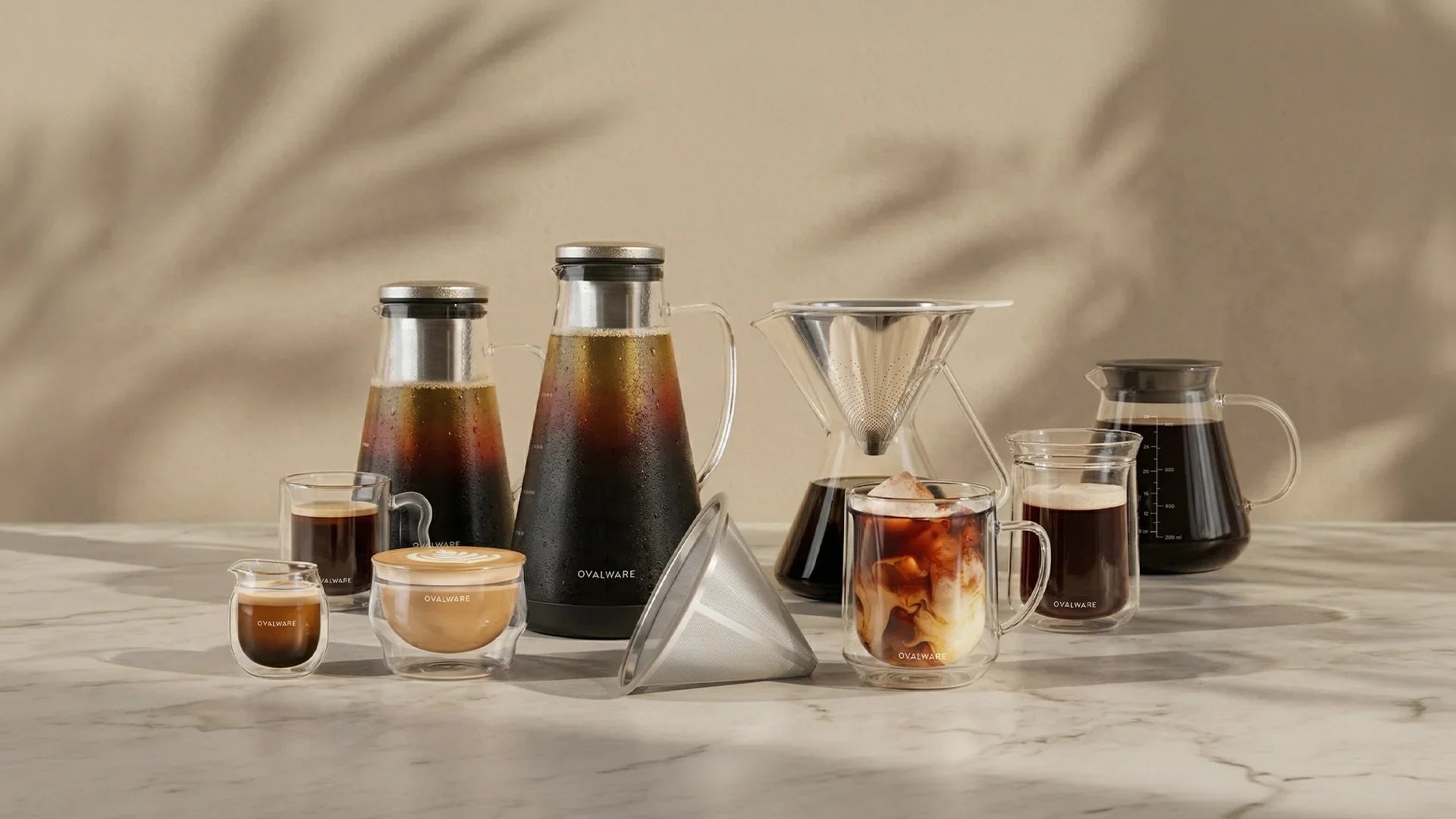
The Ovalware Pour Over Coffee Maker comes with a dual-layer stainless steel filter built in , a precision laser-cut outer layer plus an ultra-fine mesh inner layer. You never need paper filters. The filter also rests on the carafe between pours, keeping your hands free and your brew organized.
The carafe itself is 500ml borosilicate glass , exactly the right size for a full-serving flash brew. It can hold ice, absorb temperature change without cracking (borosilicate resists thermal shock), and measure your beans with the built-in markings.
| Ovalware Pour Over Coffee Maker | |
|---|---|
| Capacity | 500ml / 17oz |
| Filter | Dual-layer stainless steel , no paper filters needed |
| Material | Borosilicate glass (thermal shock resistant) |
| Includes | Carafe + filter + lid (3 pieces total) |
| Dishwasher safe | Yes (both pieces) |
| Price | $46.99 |
Shop the Pour Over Coffee Maker , $46.99
If you already have a different pour over brewer and want to upgrade to a reusable stainless filter, the Ovalware Stainless Steel Coffee Filters fit most standard cone-style pour over brewers. Available in Silver, Gold, Rose Gold, and Aura Silver.
Free shipping on US orders $65+.

Common Flash Brew Mistakes (And How to Fix Them)
- Watery result: You didn't use enough coffee, or too much ice melted before the brew finished. Try less ice and a faster pour. Or increase your coffee dose by 2-3 grams.
- Bitter taste: Over-extracted. Grind slightly coarser, use water at a slightly lower temperature (195°F instead of 205°F), or speed up your pour.
- Sour or sharp taste: Under-extracted. Grind slightly finer, use hotter water, or slow down your pour to extend contact time.
- Flat, no aroma: Coffee is too old or grind is too coarse. Use fresher beans and go finer on the grind.
- Ice melted completely before brew finished: You poured too slowly. Try a faster, more aggressive pour , or start with more ice.
Frequently Asked Questions
What is iced pour over coffee?
Iced pour over (also called Japanese iced coffee or flash brew) is a method where hot water is poured over coffee grounds directly onto ice. The brew is chilled instantly as it drips, preserving bright, aromatic flavors that slow cold brewing can mute. It's ready in 4-5 minutes instead of 12-24 hours.
What is the best ratio for Japanese iced coffee?
The standard ratio is 1:15 (1g coffee per 15g total liquid), with roughly 60% of the liquid as hot water and 40% as ice by weight. For a 250ml serving, use about 17g of coffee, 160ml of hot water, and 100g of ice. Adjust to taste , some people prefer 1:14 for a stronger result.
Can I make flash brew without a gooseneck kettle?
Yes. A regular kettle works , just pour slowly and carefully. A gooseneck kettle gives you more control over where the water lands (important for even extraction), but it's not required. Start with a slow, steady pour from any kettle and you'll get good results.
Does flash brew have more caffeine than cold brew?
Flash brew caffeine levels are comparable to hot-brewed coffee , determined mainly by your coffee dose and grind size. Ready-to-drink cold brew at a 1:12-1:14 ratio is similar in caffeine per oz. Cold brew concentrate (1:4-1:5) would have much more per ounce, but it's meant to be diluted before drinking.
What's the best grind size for iced pour over?
Medium-fine , the same grind you'd use for standard hot pour over. Think slightly finer than table salt. Avoid very fine (espresso-style) or very coarse (cold brew-style) grinds. If your brew takes longer than 5 minutes to drip, go slightly coarser.
Try It This Week
If you've been making cold brew on a Sunday and waiting 18 hours to drink it, flash brew is the method that changes your weekday morning. Same great iced coffee, done in the time it takes to boil water.
For more on pour over coffee, check out our guide to pour over coffee ratios , the same principles apply here, adapted for ice. And if you want to explore both methods, our cold brew vs iced coffee comparison breaks down which one fits your lifestyle best.
The everyday magic is in the method. Once you've tasted a proper flash brew, regular iced coffee tastes like it's missing something.