
Coffee to Water Ratio: The Complete Guide for Every Brew Method
Most coffee problems come back to one thing: the wrong ratio of coffee to water.
Too much water and your cup tastes weak and watery. Too little and it's bitter, harsh, and undrinkable. The frustrating part? Most brewing guides throw out a single number and call it a day — as if the same ratio works for cold brew and espresso.
It doesn't.
This guide gives you the exact coffee to water ratio for every common brew method, a quick-reference chart, and the simple rule that makes it all make sense. Whether you're dialing in your pour over or making cold brew for the week, you'll have the number you need in under a minute.
What "Coffee to Water Ratio" Actually Means
The coffee to water ratio is the weight of dry coffee grounds divided by the weight of water used — expressed as a simple number like 1:15 or 1:16.
That means for every 1 gram of coffee, you use 15 or 16 grams of water. That's it. No tablespoons, no scoops, no guessing. Weight-based ratios are the standard used by specialty coffee professionals because volume measurements (tablespoons, cups) vary wildly depending on grind size and how tightly you pack. A study by the Specialty Coffee Association found that weight-based brewing is the single most reliable predictor of consistent extraction quality — and it's why every serious home brewer eventually buys a scale.
Water makes up approximately 98% of your cup of coffee. Getting that ratio right is the highest-leverage thing you can do to improve the taste of your brew.
The SCAA Golden Ratio (Your Starting Point)
The baseline ratio recommended by the Specialty Coffee Association is 1:17 to 1:18 — meaning 1 gram of coffee per 17-18 grams of water.
This is officially called the SCAA Golden Cup Standard, and it applies primarily to drip and filter brewing methods. At 1:18, you're using approximately 55 grams of coffee per liter of water — enough to hit the SCAA's target extraction range of 18–22% and a total dissolved solids (TDS) of 1.15–1.35%.
Think of 1:17 as your default. From there, you adjust based on brew method, roast level, and personal preference. Light roasts often need a slightly stronger ratio (1:15) because they're denser and extract more slowly. Dark roasts dissolve faster and can taste over-extracted at the same ratio.
Coffee to Water Ratio Chart — All Brew Methods
| Brew Method | Ratio Range | Most Common | Strength Notes |
|---|---|---|---|
| Drip / Auto | 1:15 – 1:18 | 1:17 | Balanced, SCAA standard |
| Pour Over (V60, Chemex) | 1:15 – 1:17 | 1:16 | Clean, bright |
| Cold Brew Concentrate | 1:4 – 1:5 | 1:4 | Dilute 1:1 before drinking |
| Cold Brew (ready-to-drink) | 1:12 – 1:14 | 1:12 | Drink straight over ice |
| French Press | 1:12 – 1:15 | 1:13 | Bold, full-bodied |
| AeroPress | 1:10 – 1:16 | 1:12 | Flexible, concentrated |
| Espresso (double shot) | 1:2 – 1:2.5 | 1:2 | ~18g in, 36g out |
Save this chart. It covers every method you'll use at home.
Pour Over Coffee Ratio
The ideal pour over coffee ratio is 1:15 to 1:16 — meaning 1 gram of coffee for every 15 to 16 grams of water. For a standard 300ml cup, that's 18–20 grams of coffee. Use 1:15 for a bolder cup, 1:16 for something cleaner and brighter.
Pour over is one of the most ratio-sensitive brew methods because there's no pressure to compensate for a weak dose. What you put in is exactly what comes out. At 1:16, a medium roast should hit a balanced extraction — not too bright, not too heavy.
A few things that affect this:
- Grind size: Finer grinds extract faster, so you can use slightly less coffee. Coarser grinds need a slightly stronger dose.
- Roast: Light roasts are denser and need more contact time. A 1:15 ratio gives you a bit of insurance.
- Filter type: Paper filters absorb some oils and produce a cleaner cup. Metal filters (like the reusable stainless steel filter in Ovalware's Pour Over Coffee Maker) let more oils through, adding body — you might prefer 1:16 to 1:17 to balance it out.
For V60 specifically, World Brewers Cup competitors typically land between 1:15 and 1:16.5. James Hoffmann's widely cited recipe uses 15 grams of coffee to 250 grams of water — a ratio of exactly 1:16.7.

Cold Brew Coffee Ratio
The standard cold brew ready-to-drink ratio is 1:12 to 1:14 — meaning 1 gram of coffee per 12 to 14 grams of cold water. For a concentrate you plan to dilute, drop to 1:4 to 1:5 and mix with equal parts water or milk before drinking. Steep 12–24 hours in the refrigerator either way.
Cold brew uses more coffee than hot methods because cold water extracts slowly. Research from Toddy shows cold brew has 60–70% lower acidity than hot-brewed coffee — a key reason many people prefer it. The longer steep time at cold temperatures compensates for the gentler extraction, and the higher coffee dose ensures you still get full, rounded flavor.
Which ratio should you use?
- If you're drinking it straight over ice: 1:12 to 1:14
- If you want a concentrate to mix with milk, water, or use in recipes: 1:4 to 1:5
- If you like your cold brew on the stronger side: 1:10 to 1:11
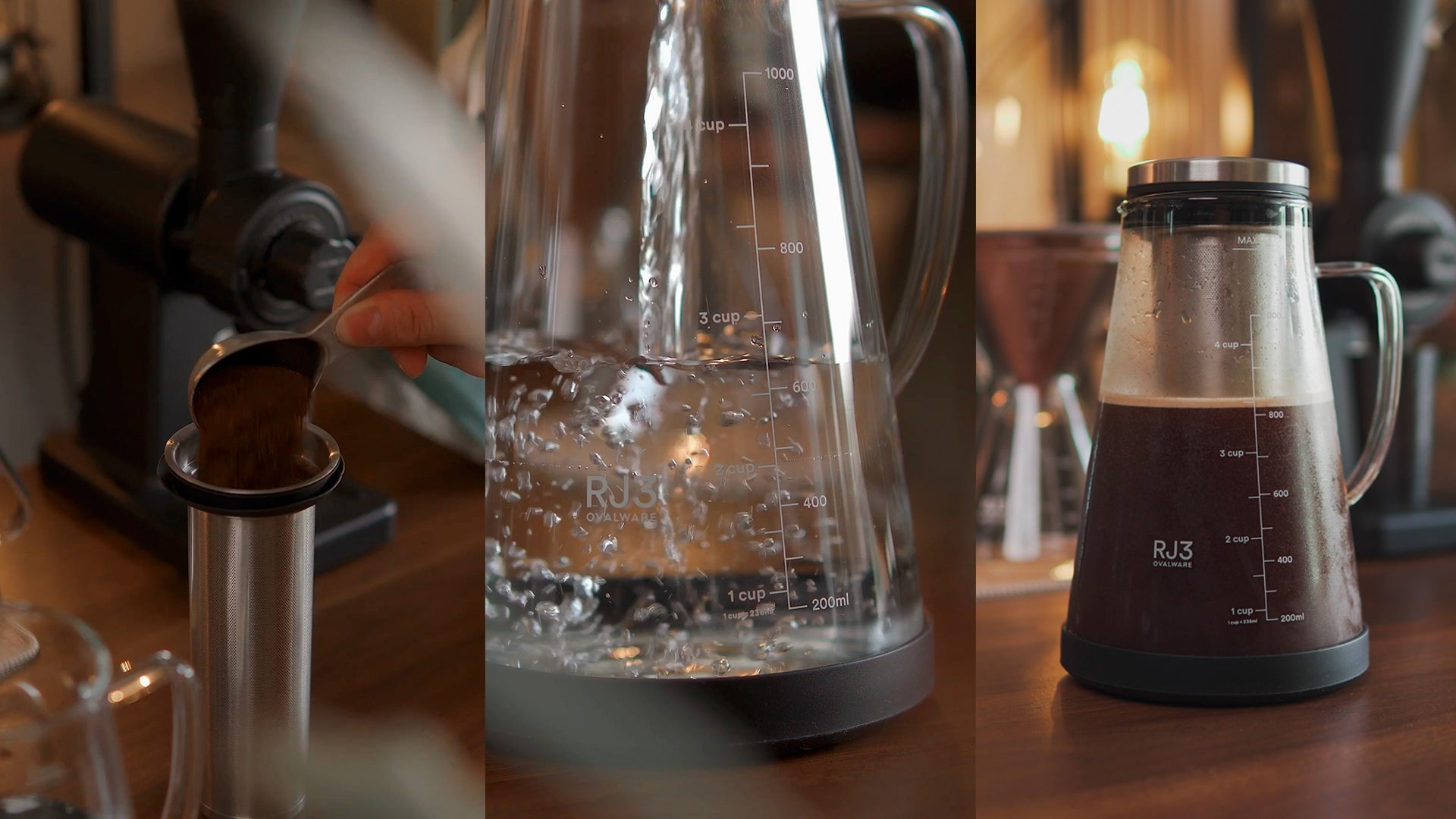
For the Ovalware Cold Brew Maker, the recommended dose for ready-to-drink cold brew is 85g of coffee for the 1.0L size and 110g for the 1.5L size — both filled with cold water to capacity. That works out to a 1:12 ratio for the 1.0L and a 1:14 ratio for the 1.5L. See the full step-by-step cold brew guide for grind size and steeping time recommendations.

Drip Coffee Ratio
The sweet spot for automatic drip machines is 1:15 to 1:18, with 1:17 as the standard.
Most drip machines are calibrated around this range — but the default "fill line" on most carafes assumes weak coffee by specialty standards. If your drip coffee tastes thin or flat, your machine's suggested dose is probably too low.
A practical starting point: 60 grams of coffee per liter of water (equivalent to 1:16.7). For a standard 12-cup (1.8L) carafe, that's around 108 grams. Adjust by 5 grams up or down depending on roast and preference.
French Press Ratio
French press uses a full-immersion brewing method — the grounds sit in the water the entire time rather than water passing through them. This produces a heavier, oilier cup, so you can go slightly lower on the dose.
The ideal range is 1:12 to 1:15, with most recipes landing at 1:13. For a 350ml press, that's about 27 grams of coffee. French press also uses a coarser grind than pour over, which affects extraction speed — this is another reason the ratio can run a bit leaner.
How to Measure Without a Scale
A kitchen scale is the most accurate tool, but if you don't have one yet, here's a workable shortcut: 2 level tablespoons of medium-ground coffee weighs approximately 10–12 grams.
That means for a 300ml pour over at a 1:16 ratio (18.75g coffee), you'd use about 3 level tablespoons. For a 1.0L batch of cold brew at 1:12 (85g coffee), that's roughly 14 tablespoons — or just under 1 cup.
The problem with tablespoons is that grind size changes the weight per scoop dramatically. A tablespoon of coarse cold brew grind weighs less than a tablespoon of fine espresso grind. A scale removes all of this guesswork and costs about $10. It's the best upgrade you can make to your home coffee setup.
Adjusting Your Ratio: 3 Rules
- Weak coffee: use more coffee, not less water. Adding more water dilutes the brew further. If your cup tastes watery, increase your dose — try dropping from 1:17 to 1:15 before changing anything else.
- Bitter coffee: use less coffee or coarsen your grind. Bitterness usually signals over-extraction. A slightly leaner ratio (1:17 or 1:18) combined with a coarser grind often fixes it without sacrificing body.
- Adjust in 1-gram increments. Ratio changes have a big impact. A 2-gram swing in a 300ml cup is immediately noticeable. Small adjustments are easier to dial in.
Frequently Asked Questions
What is the best coffee to water ratio?
The best starting ratio for most brew methods is 1:15 to 1:17 — 1 gram of coffee per 15 to 17 grams of water. The SCAA Golden Cup Standard recommends 1:18 for drip coffee. Cold brew requires a much stronger ratio of 1:4 to 1:8 because cold water extracts more slowly than hot water.
How much coffee do I use for 1 cup of water?
One cup of water is approximately 240ml (8 oz) and weighs 240 grams. At a 1:16 ratio, you'd use 15 grams of coffee — roughly 2 level tablespoons. At 1:15, use 16 grams for a slightly stronger cup.
What is the coffee to water ratio for cold brew?
For ready-to-drink cold brew, use a 1:12 to 1:14 ratio — 1 gram of coffee per 12 to 14 grams of cold water. For a concentrate you plan to dilute with milk or water, use 1:4 to 1:5. Both methods steep 12–24 hours in the refrigerator.
Does the ratio change for light vs. dark roast?
Yes. Light roasts are denser and extract more slowly, so a slightly stronger ratio (1:15) compensates. Dark roasts extract faster and can turn bitter at stronger ratios — start at 1:16 to 1:17 and adjust from there.
What ratio does the Specialty Coffee Association recommend?
The SCA Golden Cup Standard recommends 55 grams of coffee per liter of water for brewed coffee (drip/filter methods) — approximately a 1:18 ratio — with a target extraction yield of 18–22% and TDS of 1.15–1.35%.
The Takeaway
Get the ratio right and everything else — grind size, water temperature, brew time — becomes a refinement. Get it wrong and nothing else matters.
Here's the short version:
- Pour over: 1:15–1:16
- Cold brew (ready to drink): 1:12–1:14
- Cold brew concentrate: 1:4–1:5
- Drip: 1:15–1:18
- French press: 1:12–1:15
Start with these numbers, brew, taste, and adjust by 1 gram at a time until it's exactly what you want. That's the whole system.
If you're starting your cold brew journey, the Ovalware Cold Brew Maker takes the guesswork out — the 1.0L and 1.5L sizes are both sized for the 1:12 to 1:14 ready-to-drink ratio, so you just fill and steep. See the full pour over brewing guide and cold brew step-by-step for everything beyond the ratio.