Why Your Cold Brew Tastes Bitter (And How to Fix It)
You made cold brew, waited 12 hours, and it came out bitter instead of smooth. That's frustrating , especially because bitter cold brew isn't supposed to happen. Cold water extraction is specifically why people make cold brew: it's slower, gentler, and naturally produces a sweeter, less acidic cup than hot brewing.
So when cold brew tastes bitter, something in the process went wrong. The good news is that it's almost always fixable with one small change. Here are the six most common causes , and exactly what to do about each one.
Why Does Cold Brew Taste Bitter?
Cold brew tastes bitter most commonly because of over-extraction: the coffee steeped too long, was ground too fine, or was brewed at too high a coffee-to-water ratio. A less common cause is sediment from fine grounds seeping through the filter and continuing to extract in the carafe. All of these are easy to fix once you identify which one is happening.
Cause 1: You Steeped It Too Long
This is the most common cause of bitter cold brew by a wide margin. Over-extraction happens when the coffee grounds steep longer than they need to , the sugars and acids that make cold brew taste good extract first, and the bitter compounds extract last. If you let the steep go too long, you get more of the bitter compounds than you want.
The fix: Follow a strict steep window and pull the filter at the right time. The correct steep times are:
- In the fridge: 12-18 hours. Pull the filter at 12 hours for a lighter cup; 18 hours for a more concentrated, fuller-bodied result. Don't go past 18 hours in the fridge.
- At room temperature: 8-12 hours. Room-temperature brewing extracts faster because warmer water (even at ambient temperature) is more solvent than near-freezing fridge water. Don't go past 12 hours at room temp.
If you've been steeping for 24 hours because you read that somewhere, that's almost certainly your bitterness culprit. Set a timer from now on.
Our full guide to how long to steep cold brew coffee covers the 12, 18, and 24-hour question in detail , including how temperature affects the process and why fridge brewing gives you more control.

Cause 2: Your Grind Is Too Fine
Grind size directly controls how fast compounds extract from the coffee grounds. Fine grounds have more surface area in contact with water, which means they extract faster , including the bitter compounds you're trying to avoid.
Cold brew requires a coarse grind. If you're using a medium or fine grind (the kind meant for drip machines, pour over, or espresso), you're over-extracting before the steep is even half done.
What coarse looks like: Roughly the texture of raw sugar or coarse sea salt. Individual grounds should be visible and distinct , not powdery, not clumped. If your grounds look like fine sand, they're too fine for cold brew.
The fix: Adjust your grinder to a coarser setting. If you're using pre-ground coffee, look for a bag labeled "cold brew grind" or "coarse grind." Most grocery store pre-ground coffees are ground for drip machines (medium grind) and will over-extract in cold brew.
Our cold brew grind size guide has the exact grinder settings for the most common home grinders, plus how to tell by sight and feel whether your grind is in the right range.
Ovalware-specific note: The Ovalware Cold Brew Maker uses a stainless steel fine-mesh filter. If your grind is too fine, small grounds can seep through the filter and settle into the coffee. Those grounds continue extracting in the carafe even after you've removed the filter , adding bitterness over time. If your cold brew tastes fine on day one and bitter on day two, fine grind seeping through the filter is almost certainly the cause. Go extra coarse to prevent this.
Cause 3: Your Coffee-to-Water Ratio Is Too High
Using too much coffee relative to the water doesn't just make your cold brew stronger , it can make it bitter. More coffee in the same volume of water means higher extraction rates and more bitter compounds making it into the final brew.
Correct ratios for the Ovalware Cold Brew Maker:
- 1.0L / 34oz maker: ~85g (about 3oz) coarse-ground coffee per 1 liter of water. This is approximately a 1:12 coffee-to-water ratio.
- 1.5L / 51oz maker: ~110g (about 4oz) coarse-ground coffee per 1.5 liters of water. This is approximately a 1:14 ratio.
Do not use ratios like 1:4, 1:5, or 1:8 with the Ovalware Cold Brew Maker , those are cold brew concentrate ratios designed for makers that are specifically built for concentrate brewing. The Ovalware CBM is designed to brew ready-to-drink cold brew at drinking strength. Over-dosing coffee to those concentrate ratios will extract very fast and taste bitter and harsh.
For more on ratios across different brew methods, see our complete coffee-to-water ratio guide.
Cause 4: You Used Warm or Hot Water
This one sounds obvious, but it happens more often than you'd think , especially if you filled the maker with water straight from the tap in summer, when tap water can be 70-75°F / 21-24°C.
Cold brewing works because cold water extracts slowly. Warm or hot water extracts the same bitter compounds that hot brewing does, just a bit more slowly. If your tap water was warm or you forgot to chill the water first, the extraction rate was closer to hot brewing than cold brewing, and bitterness follows.
The fix: Use filtered cold water straight from the fridge, or fill with tap water and then move the entire maker into the fridge immediately. If it's a hot day and your tap water is warm, run the cold tap for 30 seconds before filling, or add a few ice cubes to the water before adding the grounds.
Cause 5: The Coffee Itself Is the Problem
Not all bitterness in cold brew comes from brewing technique. Sometimes the coffee itself is the issue.
Dark roasts: Very dark roasts (French roast, dark espresso roast) have more bitter compounds to begin with , they've been roasted to the point where the sugars have caramelized heavily and some compounds have turned bitter. Cold brewing can't fully compensate for this. If you're using a very dark roast and your cold brew is bitter, try a medium roast instead.
Stale coffee: Old coffee that's gone stale doesn't just taste flat , it can taste bitter and papery. Coffee starts losing freshness within days of roasting if stored poorly, and within 2-4 weeks even with good storage. If your coffee smells dull when you open the bag, the cold brew will taste dull and potentially bitter.
The fix: Use coffee roasted within the past 2-4 weeks, stored in an airtight container away from light and heat. For cold brew specifically, medium roast or medium-dark roast gives you the best balance of sweetness and complexity , not harsh, not bland.
Cause 6: Sediment Settling in the Carafe
With a stainless steel filter like the one in the Ovalware Cold Brew Maker, very fine coffee particles can pass through the mesh and settle at the bottom of the carafe. When you pour, those grounds swirl up and add bitterness to the cup. The longer the brewed cold brew sits in the fridge, the more extraction happens from the settled sediment.
The fix: There are three approaches:
- Go coarser: Increasing your grind size reduces how many fine particles pass through the filter in the first place. This is the most effective long-term fix.
- Pour from the top: Tilt the carafe gently and pour from above the sediment layer, leaving the last ounce or two in the carafe. The sediment concentrates at the bottom.
- Secondary filter: If you're very sensitive to sediment, pour your brewed cold brew through a paper filter or a fine cloth strainer before storing it. This removes nearly all fine particles.
How to Make Smooth Cold Brew With the Ovalware Cold Brew Maker
Apply all six fixes above and your cold brew should taste smooth, naturally sweet, and clean , exactly what cold extraction is designed to produce. Here's the full checklist:
- Coarse grind (texture of raw sugar)
- Correct ratio: ~85g per liter (1.0L maker) or ~110g per 1.5L (1.5L maker)
- Cold filtered water
- 12-18 hours in the fridge (or 8-12 hours at room temperature)
- Pull the filter at the right time , set a timer
- Fresh, medium-roast coffee roasted within the past 2-4 weeks

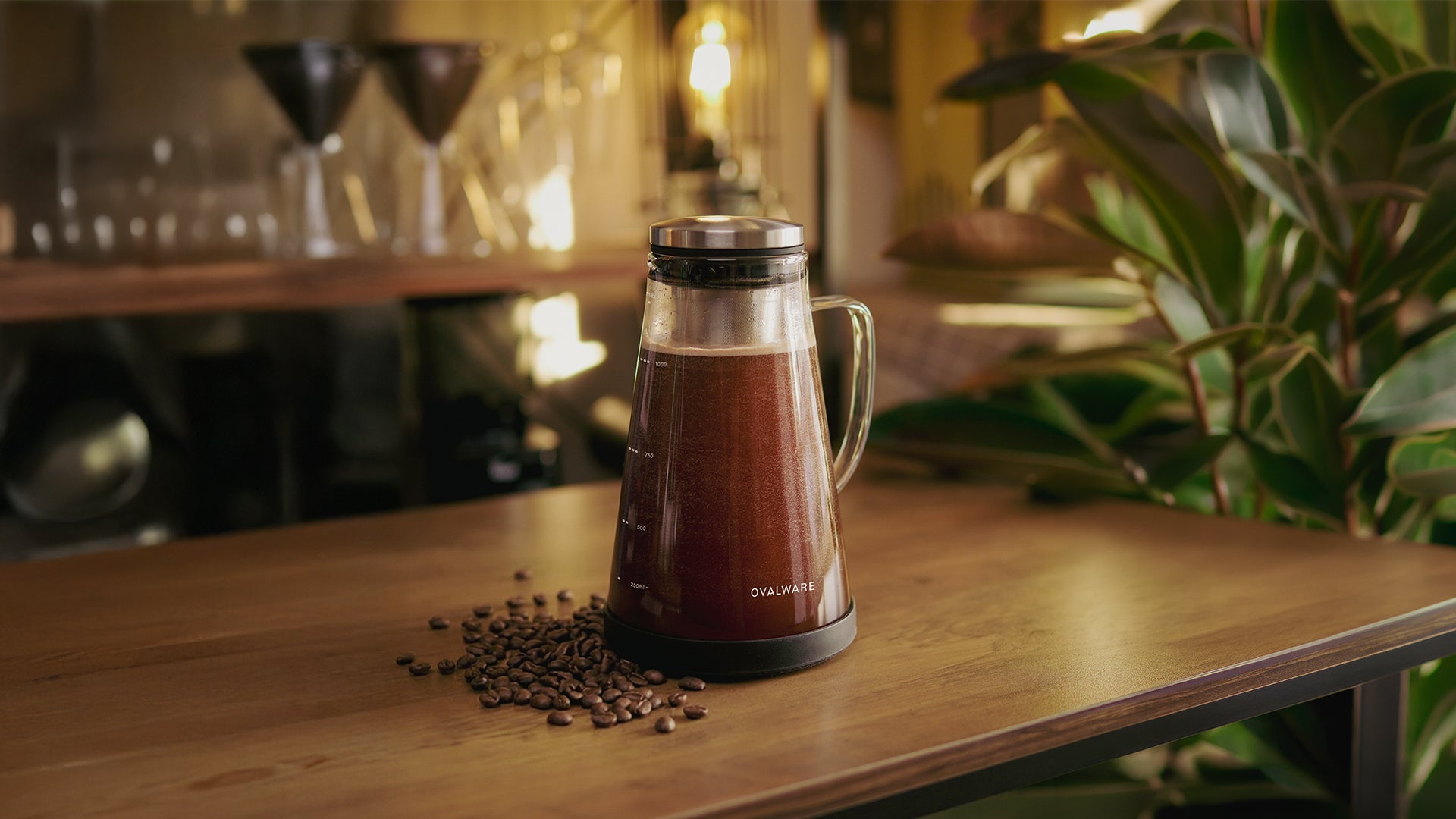
The Ovalware Cold Brew Maker makes ready-to-drink cold brew , no dilution needed before drinking. It's borosilicate glass with a stainless steel filter, microwave safe, dishwasher safe, and works as a serving carafe too. Available in 1.0L / 34oz ($40.99) and 1.5L / 51oz ($46.99).
| Feature | Ovalware Cold Brew Maker |
|---|---|
| Sizes | 1.0L / 34oz and 1.5L / 51oz |
| Carafe material | Borosilicate glass |
| Filter | Stainless steel fine-mesh |
| Brewing ratio | ~85g per liter (1:12) for 1.0L; ~110g per 1.5L (1:14) |
| Steep time (fridge) | 12-18 hours |
| Steep time (room temp) | 8-12 hours |
| Dishwasher safe | Yes |
| Price | $40.99 (1.0L) / $46.99 (1.5L) |
Quick Troubleshooting Reference
| Symptom | Most Likely Cause | Fix |
|---|---|---|
| Bitter from the first sip | Over-steeped or too fine a grind | Reduce steep time; coarsen the grind |
| Gets more bitter over days in the fridge | Fine sediment settling and extracting | Go extra coarse; pour from the top |
| Bitter AND weak | Grind too fine, extracted too fast and flat | Coarsen grind, reduce steep time |
| Harsh and astringent | Ratio too high (too much coffee) | Reduce to correct ratio (1:12 or 1:14) |
| Bitter even with right technique | Dark roast or stale coffee | Switch to a fresher, medium roast |
Frequently Asked Questions
Why is my cold brew bitter when hot coffee isn't?
Hot brewing is much faster and more forgiving , small mistakes don't have 12 hours to compound. Cold brew, because it steeps for so long, is more sensitive to grind size and steep time. A grind that's slightly too fine or a steep that's slightly too long produces noticeably more bitterness in cold brew than the same mistake would in a 4-minute pour over.
Can I fix cold brew that's already bitter?
To a degree. Diluting it with water reduces the intensity of all flavors including bitterness. Adding a small amount of simple syrup (1-2 teaspoons per cup) can mask bitterness by balancing it with sweetness. Adding milk or cream softens the bitterness significantly. But the real fix is correcting the next batch , once cold brew is over-extracted, you can soften it but you can't un-extract it.
Does the type of coffee bean affect bitterness?
Yes. Robusta beans are naturally more bitter than Arabica, though most specialty coffee is 100% Arabica. Within Arabica, very dark roasts have more bitter compounds than medium roasts. Single-origin light roasts can have bright acidity that reads as bitter to some palates , if that's happening, try a medium-roast blend instead.
Does cold brew become bitter if stored too long in the fridge?
Yes , but the mechanism is different from over-extraction during brewing. If you have fine sediment in the carafe from grounds seeping through the filter, those grounds continue to extract slowly in the fridge. Cold brew without sediment stays smooth and stable for 7-14 days in the fridge. Cold brew with fine sediment can turn noticeably bitter within 2-3 days as the settled grounds keep extracting.
Is bitter cold brew safe to drink?
Yes. Bitter cold brew is unpleasant but not unsafe. The bitterness comes from over-extracted coffee compounds , tannins, chlorogenic acids, and caffeine itself (which is naturally bitter). None of these are harmful. If your cold brew smells sour, vinegary, or off rather than just bitter, that's a sign of bacterial growth and you should discard it , but that requires very warm conditions or very long storage, not just over-extraction.
Sources: Specialty Coffee Association, Cold Brew Guidelines (2021); Perfect Daily Grind, "Cold Brew Extraction Science"; National Coffee Association, coffee storage best practices; Barista Magazine, "Understanding Coffee Bitterness"; SCAA Coffee Tasters Flavor Wheel; UC Davis Coffee Center research on cold brew extraction chemistry; Journal of Food Science, "Effect of Brewing Parameters on Cold Brew Coffee Flavor."