Cold Brew Maker vs French Press: Which Makes Better Coffee?
You already own a French press. So it's a fair question: why spend another $40 on a dedicated cold brew maker when you could just steep grounds in the pot sitting on your counter right now?
Both methods work on the same basic idea: full immersion, cold water, a long steep. Cold coffee is one of the fastest-growing categories in the industry right now, so more people than ever are asking this exact question before they buy anything new.
Where a cold brew maker and a French press genuinely diverge is what happens after the steep, and that difference shows up in your glass as grit, cloudiness, or a clean, bright pour. This post breaks down the real tradeoffs: filtration and grit, flavor clarity, ease of use, cleanup, cost, and capacity. We're not going to pretend the French press is a bad choice. It's a fine tool a lot of people already own, and there are honest reasons to keep using it. But there are also specific, measurable reasons a dedicated cold brew maker produces a cleaner cup, and we'll walk through exactly what those are.
Cold Brew Maker vs French Press: Side-by-Side Comparison
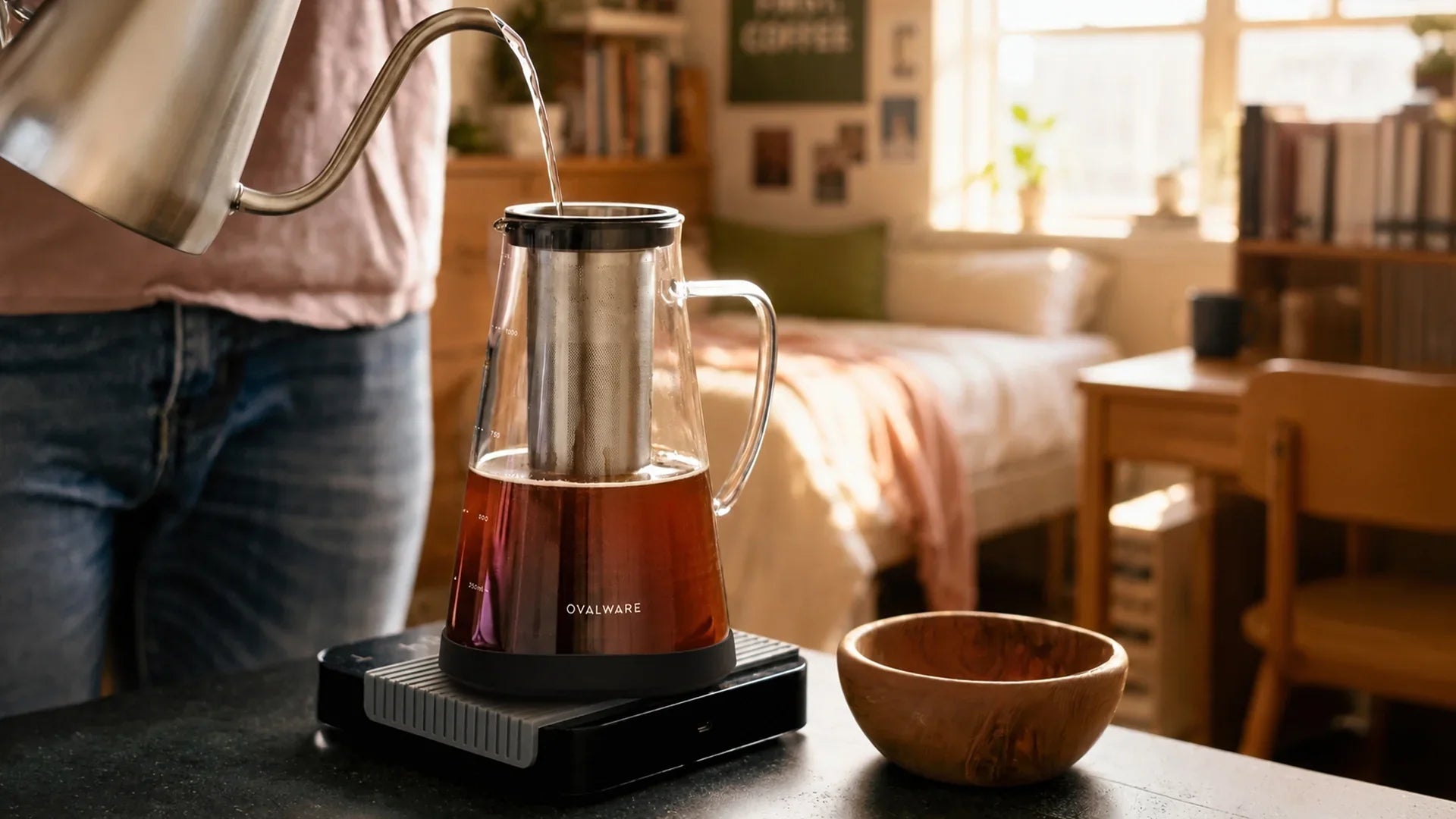
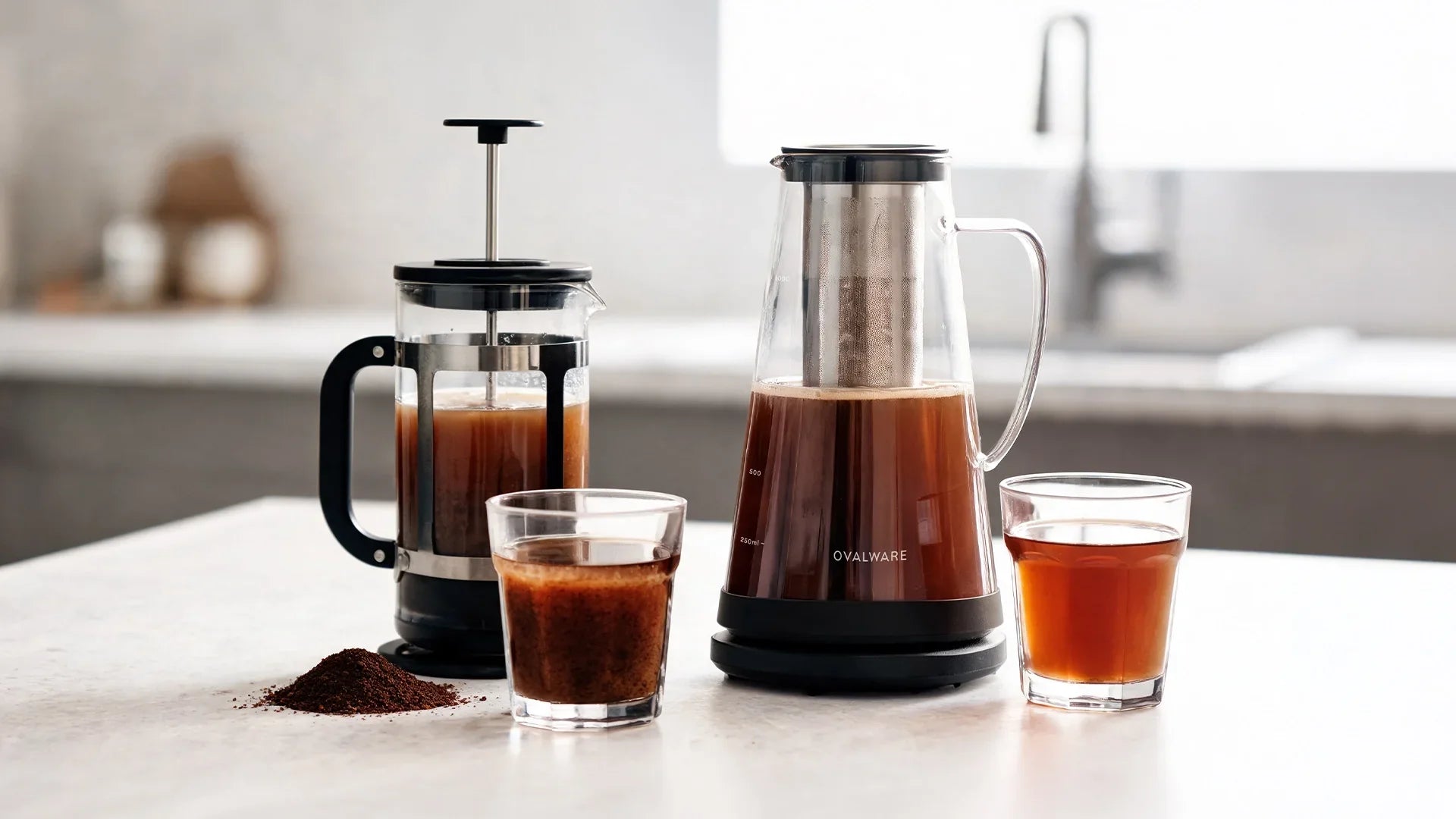
A dedicated cold brew maker uses a stainless steel fine-mesh filter built into the lid, so grounds stay separate from your coffee with no straining or pouring through cheesecloth required. A French press works for cold brew too, but its looser plunger mesh lets more fine particles through, and most people strain the batch a second time before drinking it.
Both are full-immersion brewers, meaning the grounds sit directly in the water for the entire steep instead of water passing through them once, the way a drip machine or pour-over works. That's part of why cold brew tastes smooth and low in bitterness compared to hot coffee. Where the two methods split is filtration. The Ovalware Cold Brew Maker's stainless steel mesh is sealed into the glass carafe's lid, so you pour straight from the fridge into a glass with no separate straining step. A French press's plunger mesh was designed for a 4-minute hot brew, not a 12 to 24 hour cold steep, so fine grounds have far more time to work their way through. That's the root of the "gritty French press cold brew" complaint you'll find on coffee forums and Reddit threads. Cold brew is now the most requested cold coffee style tracked by the National Coffee Association's Cold Brew & RTD Data Trends report, and the cold coffee category grew 21% year-over-year in summer 2025 according to NCA data reported by Daily Coffee News.
| Factor | French Press | Ovalware Cold Brew Maker |
|---|---|---|
| Price | $0 if you already own one; roughly $25-$45 new | $40.99 (1.0L/34oz) or $46.99 (1.5L/51oz) |
| Capacity | Typically 12oz-51oz depending on model | 34oz or 51oz |
| Filtration | Single-layer plunger mesh, roughly 200-300 microns | Sealed stainless steel fine-mesh filter built into the lid |
| Grit/sediment | Common with cold steeps; usually needs a second strain | Minimal; filter is purpose-built for long cold steeps |
| Ease of pour | Plunge slowly, pour carefully to avoid disturbing grounds | Pour straight from the sealed carafe, no plunging |
| Cleanup | Disassemble plunger, rinse mesh, grounds packed at bottom | Dishwasher-safe carafe and filter, no disassembly |
| Dual-purpose use | Also brews hot coffee, its original job | Also works as a hot-coffee serving carafe |
| Steep time | 12-24 hours, commonly made concentrate-style | 12-18 hours fridge, or 8-12 hours room temperature |
The rest of this post breaks down the rows that matter most for daily use: filtration, flavor clarity, and how much extra work each method actually takes. If you're weighing a cold brew maker vs French press purely on those three things, keep reading.
Filtration and Grit: Why French Press Cold Brew Turns Out Muddy
Standard French press mesh filters typically range from about 200 to 300 microns, wide enough that fine coffee particles pass straight through during a 12 to 24 hour steep. A dedicated cold brew maker uses a finer, purpose-built stainless steel mesh sealed into the lid, so far less sediment ends up in your glass.
Independent testing from equipment review site First French Press found that single-mesh French presses averaged 1.2 grams of sediment per 8-ounce cup, compared to 0.26 grams from a double-filter system, a 78% reduction. That's the same principle at work in a dedicated cold brew maker: a finer, purpose-built mesh traps more fine particles before they ever reach your glass. Over a 12 to 24 hour steep, even small amounts of sediment settle and cloud the brew, which is why French press cold brew often needs a second strain through a paper filter or fine mesh sieve before it's ready to drink. French press micron ratings vary a lot by brand and age, and filters wear wider over time, so an older French press will typically let through more grit than a new one.
A few things help if you're sticking with the French press you already own:
- Grind coarser than you would for hot French press coffee. Fine grounds are the main culprit behind grit, and our cold brew grind size guide covers exactly how coarse to go.
- Let the pot sit for a minute after plunging so loose grounds settle before you pour.
- Strain a second time through a fine mesh strainer or paper filter for a cleaner cup.
None of these steps are hard. But they're extra work a dedicated cold brew maker's built-in filter is designed to skip. If you want the full method for hot brewing too, our guide on how to make French press coffee at home walks through grind size and timing for that side of the brewer.
Flavor Clarity: How Grit Changes the Way French Press Cold Brew Tastes
Removing more sediment doesn't just make cold brew look cleaner, it changes how it tastes. Fine coffee particles keep releasing compounds into the liquid the longer they sit in contact with it, and over a 12+ hour steep, that adds a duller, muddier edge to the finish compared to a cup filtered through a finer mesh.
This matters more for cold brew than hot coffee because the steep is so much longer. A peer-reviewed sensory study hosted by the National Institutes of Health found that cold brew coffee scored higher for floral notes and lower for bitterness, sourness, and a rubbery off-flavor compared to hot-brewed coffee made from the same beans. Grit and prolonged contact with fine particles work against that clean profile. Cold brewing overall is also meaningfully less acidic than hot brewing, with pH differences of up to 0.34 units between hot and cold brewed coffee from identical beans, according to research on the acidity and antioxidant activity of cold brew coffee. That holds true for both a French press and a dedicated cold brew maker, so you don't lose the acidity benefit either way.
The Specialty Coffee Association's brewing standards target an 18 to 22% extraction yield for a balanced cup. Fine particles trapped against a loose mesh keep extracting past that window since they're still touching liquid after the "brew" is technically done, which is part of why French press cold brew can taste flat next to the same beans run through a finer filter. Our coffee-to-water ratio guide breaks down how ratio and extraction interact across brew styles.
Ease of Use: No More Straining Grounds Through a French Press Plunger
A cold brew maker built specifically for the job lets you add coarse grounds and water, seal the lid, and pour straight from the fridge 12 to 18 hours later with no plunging or straining step. A French press requires pressing the plunger down slowly to avoid forcing fine particles through the mesh, then often straining the batch a second time anyway.
Because the Ovalware Cold Brew Maker's stainless steel filter sits sealed inside the lid, there's no plunging step. Use about 85 grams (3 ounces) of coarse-ground coffee per liter of water for the 1.0L size, roughly a 1:12 ratio, or 110 grams (4 ounces) per 1.5 liters for the larger size, roughly 1:14. Seal it, refrigerate for 12 to 18 hours (or leave it at room temperature for 8 to 12), and pour. It's ready to drink straight from the carafe, no dilution and no math required first thing in the morning. A 2023 peer-reviewed study found that a coffee-to-water ratio near 1:14 with a medium-coarse, consistent grind produced the best-quality cold brew, which lines up closely with how the 1.5L Ovalware Cold Brew Maker is designed to be used.
French press cold brew is usually made the opposite way: as a concentrate, at a much stronger ratio, commonly cited around 1:4 to 1:8, then cut with water, milk, or ice before drinking. That's not a flaw, it's a different method that gives more control over strength per cup. It just means an extra dilution step that a ready-to-drink cold brew maker skips. Research on immersion brewing found that grind size and coffee-to-water ratio both significantly affect extraction and final cup quality, which is why consistency matters more the longer a brew steeps.
Cleanup and Storage: Sealed Carafe vs Open French Press Plunger
French press cleanup means disassembling the plunger, rinsing the mesh screen and spring assembly, and knocking wet grounds out of a narrow carafe. Grounds can pack tightly against the mesh after a 12 to 24 hour cold steep, which makes the screen harder to rinse clean than after a quick 4-minute hot brew.
The Ovalware Cold Brew Maker's stainless steel filter and borosilicate glass carafe are both dishwasher safe, so cleanup is one cycle with no disassembly. The sealed lid also keeps the coffee from picking up other smells in your fridge during the long steep, which matters more than it sounds. A French press lid isn't sealed the same way, so anything else stored nearby for 12+ hours has more chance to affect the coffee's flavor. Our guide on how to clean a cold brew maker covers the full routine.
Cost, Capacity, and Versatility: When the French Press Still Wins
If you already own a French press, the honest answer is that it's the cheaper choice for cold brew, at least at first. A French press costs nothing extra if it's already in your cabinet, while the Ovalware Cold Brew Maker runs $40.99 for the 1.0L size or $46.99 for the 1.5L size.
A French press is also inherently dual-purpose. If yours already lives on your counter for hot coffee, using it for cold brew doesn't cost you a second appliance or extra shelf space. The Ovalware Cold Brew Maker also works as a hot-coffee serving carafe (it's microwave-safe borosilicate glass rated from -30°C to 180°C), but that's a secondary use case, not the main reason to buy one. Our cold brew maker buying guide covers how to decide if a dedicated maker is worth it based on how often you actually drink cold brew.
Capacity is close to a wash. Standard French presses run anywhere from about 12 ounces up to 51 ounces depending on the model, similar to the Ovalware Cold Brew Maker's 34oz and 51oz sizes. If you're making cold brew only occasionally, in small batches, and you don't mind an extra straining step, a French press you already own is a genuinely reasonable choice. There's no dishonesty in saying so.
Where the math changes is frequency. If you're brewing cold brew every few days, the grit, the second straining step, and the plunger cleanup add up fast. That's the point where a dedicated cold brew maker's built-in filtration starts saving real time, not just producing a cleaner cup.
Frequently Asked Questions
Can you make cold brew in a French press?
Yes. Add coarse grounds and cold water, stir, and let it steep for 12 to 24 hours before pressing the plunger down slowly. The main tradeoff is more sediment in the final cup, since French press mesh filters are built for a 4-minute hot brew, not a 12+ hour cold steep.
Is a dedicated cold brew maker better than a French press?
It depends on how often you make cold brew. A dedicated cold brew maker like the Ovalware Cold Brew Maker uses a finer, purpose-built stainless steel filter that produces less sediment and skips the straining step, which is worth it if you brew regularly. If you only make cold brew occasionally, a French press you already own is a reasonable, cheaper option.
Why does French press cold brew taste gritty?
French press mesh filters typically range from about 200 to 300 microns, wide enough for fine coffee particles to slip through during a long cold steep. Because the grounds stay in contact with the liquid for 12 or more hours instead of a few minutes, more fine particles end up in the final cup than in a quick hot brew.
Do you need to dilute cold brew from a cold brew maker before drinking it?
No, not with the Ovalware Cold Brew Maker. It's brewed at a ready-to-drink ratio, about 1:12 for the 1.0L size and 1:14 for the 1.5L size, so it's meant to be poured and enjoyed straight from the fridge. This is different from French press cold brew, which is often made as a stronger concentrate and diluted with water, milk, or ice before drinking.
How long does cold brew last in the fridge?
Cold brew coffee generally keeps well for about one to two weeks stored in a sealed container in the fridge, though it tastes best in the first week. Storing it in a carafe with a sealed lid helps it hold its flavor longer and keeps it from picking up other odors in the fridge.
Cold Brew Maker vs French Press: Which One Should You Buy?
If you already own a French press and only make cold brew now and then, keep using it. Grind coarser than usual, strain twice if you need to, and you'll get a decent cup for zero extra cost.
If cold brew is a regular part of your routine, or the grit and second straining step have started to bother you, a dedicated cold brew maker solves the problem at the source. The Ovalware Cold Brew Maker's sealed stainless steel filter means less sediment, no plunging, and a ready-to-drink pour straight from the fridge, no dilution required. Pour it into a Double Wall Tasting Glass to keep it cold without condensation dripping onto your counter.
Either way, you know your own coffee habits better than any blog post does. That's the honest answer, and honestly, that's kind of the point.