Mushroom Coffee: What It Is, What the Science Says, and Whether It's Worth Trying
Mushroom coffee is everywhere right now. It's in wellness influencer feeds, health food stores, and probably your coworker's morning routine. Brands like Four Sigmatic built entire businesses on it. But is it actually doing something for you, or is it just expensive coffee with a clever story? This post breaks down what mushroom coffee really is, what the science says (including the honest parts that get left out), and how to make a version of it at home that tastes genuinely good.
What Is Mushroom Coffee?
Mushroom coffee is a blend of regular coffee and powdered medicinal mushroom extracts. It's not made from mushrooms instead of coffee. It's coffee with mushroom supplements added in. The result looks and tastes mostly like coffee, with a slightly earthier flavor depending on the mushroom used.
The mushrooms used are not the kind you eat on pizza. They're functional or adaptogenic mushrooms , a category that includes species like lion's mane, chaga, reishi, and cordyceps. These have been used in traditional Chinese and Ayurvedic medicine for centuries. Modern supplement brands have turned them into powder extracts and mixed them into coffee for convenience.
Most commercial mushroom coffee products use a 1:1 blend or mix a smaller amount of mushroom extract into a larger amount of ground coffee. Some come as instant packets. Others are ground coffee blends. A few are pure mushroom powder meant to be added to your own brew.
The idea behind the combination is that the stimulating effects of caffeine pair with the calming, focus-supporting, or immune-modulating properties attributed to certain mushrooms. Whether that combination delivers on its promise is where the science gets more complicated.
The Most Common Mushrooms Used
Different mushroom coffees use different species. Here are the ones you'll see most often and what they're claimed to do.

Lion's Mane (Hericium erinaceus)
The most popular choice for focus and cognitive support. Lion's mane contains compounds called hericenones and erinacines, which some research suggests may stimulate nerve growth factor (NGF) production. It's the mushroom most associated with brain health claims.
Chaga (Inonotus obliquus)
Chaga grows on birch trees in cold climates. It's high in antioxidants and has been studied for immune support and anti-inflammatory properties. It has a naturally earthy, slightly vanilla-like flavor that blends well with coffee.
Reishi (Ganoderma lucidum)
Often called the "mushroom of immortality" in traditional medicine. Reishi is associated with stress reduction, immune support, and better sleep. It's more bitter than the others and is typically used in smaller quantities in coffee blends.
Cordyceps (Cordyceps sinensis or militaris)
Cordyceps is used for energy and athletic performance. Some research has looked at its effects on oxygen utilization and endurance. It has a mild, slightly sweet flavor that works well in coffee.
Turkey Tail (Trametes versicolor)
Turkey tail is one of the most studied medicinal mushrooms, primarily for its immune-supporting compounds called polysaccharopeptides (PSP) and polysaccharide-K (PSK). It's included in some mushroom coffee blends for its immune benefits.
What the Science Actually Says
There is legitimate research on medicinal mushrooms, and some findings are promising. But most studies are small, done on animals, or use isolated compounds rather than the amounts found in a coffee blend. The honest summary: some benefits are plausible, but the evidence is not strong enough to call it proven.
Here's what the research actually shows for the main species:
Lion's mane: A 2009 randomized controlled trial published in Phytotherapy Research found improvements in mild cognitive impairment in older adults who took lion's mane supplements over 16 weeks. A 2019 review in the International Journal of Molecular Sciences confirmed the neuroprotective potential of its key compounds. That said, most human trials are small and short-term. Examine.com's summary rates the evidence as preliminary but real.
Chaga: Research has focused mostly on antioxidant content and in vitro (cell culture) studies. A 2019 review in the Journal of Ethnopharmacology found strong antioxidant activity but noted the need for more human clinical trials before firm conclusions can be drawn.
Reishi: A Cochrane Review on reishi mushroom for cancer care found it may support immune response alongside conventional treatment, but cautioned against using it as a standalone treatment. Healthline's overview describes the evidence as "mostly preliminary."
Cordyceps: A 2017 study in the Journal of Dietary Supplements found cordyceps militaris supplementation improved peak oxygen uptake (VO2 max) in healthy older adults. Other studies have shown mixed results for athletic performance. The evidence is promising but not conclusive.
Turkey tail: This is arguably the best-researched mushroom in the group. PSK extracted from turkey tail has been used alongside cancer treatment in Japan for decades. The National Cancer Institute's PDQ page covers the research in depth. Most studies use concentrated extracts, not the amounts in a typical coffee blend.
One important caveat across all of this: WebMD notes that the amounts of mushroom extract in commercial coffee blends are typically much lower than the doses used in clinical studies. So even if the research on a compound is solid, it doesn't automatically mean your morning cup is delivering a meaningful dose.
Potential Benefits Worth Knowing
Even with the caveats above, there are real reasons people reach for mushroom coffee. Here's what the research supports, stated accurately.
- Lower caffeine, same ritual. Many mushroom coffee blends contain less caffeine than regular coffee. For people who are sensitive to caffeine but love the morning coffee habit, mushroom coffee can be a useful middle ground. The New York Times Wirecutter covered this appeal in their mushroom coffee roundup.
- Antioxidant boost. Medicinal mushrooms are genuinely high in antioxidants. Coffee itself is already one of the richest dietary sources of antioxidants for most Americans. Combining the two is not a bad idea from a nutritional standpoint.
- Adaptogen support. Adaptogens are substances thought to help the body manage stress. Reishi and lion's mane are classified as adaptogens. The Food Revolution Network's guide to mushroom coffee provides a solid overview of adaptogens and how they're thought to work.
- Gentler on digestion. Some people report that mushroom coffee is easier on the stomach than straight coffee. The lower acidity in some blends may be a factor. This is largely anecdotal but widely reported.
- Focus without jitters. The combination of lion's mane and lower caffeine is what most brands market for "clean focus." Some users report feeling alert without the anxious edge that high-caffeine coffee can cause. Individual results vary significantly.
The Limitations (Be Honest About These)
Mushroom coffee has real enthusiasts, but it also has real limitations that deserve a straight answer.
- Most studies are not on the coffee product itself. Studies on lion's mane or reishi use concentrated extracts at specific doses. A sachet of mushroom coffee contains a fraction of that. The research does not automatically transfer.
- Small sample sizes. Many mushroom studies involve fewer than 100 participants, often older adults, and run for 8 to 16 weeks. That's not enough to draw broad conclusions.
- Animal studies dominate. A lot of the most dramatic findings come from animal models. Results in mice don't always hold up in humans, as Examine.com explains well.
- Expensive relative to regular coffee. Mushroom coffee can cost 3 to 5 times more than a bag of quality whole bean coffee. If the active dose is uncertain, that's a meaningful tradeoff.
- Taste varies a lot. Some blends taste barely different from regular coffee. Others have a strong earthy flavor that not everyone enjoys. Finding one you like might take some trial and error.
- Supplement regulation is loose. In the United States, the FDA does not evaluate most mushroom supplements for efficacy before they go to market. Third-party testing matters here. Look for brands that publish certificates of analysis.
None of this means mushroom coffee is a bad idea. It just means going in with clear expectations is smarter than expecting a miracle. It's a functional food with some supportive research, not a pharmaceutical.
How to Make Mushroom Cold Brew at Home
One of the best ways to experiment with mushroom coffee is to make it as cold brew. Cold brewing reduces acidity, which lets the earthy notes of mushroom powder integrate smoothly. And because cold brew is made in batches, you can control exactly what goes in.

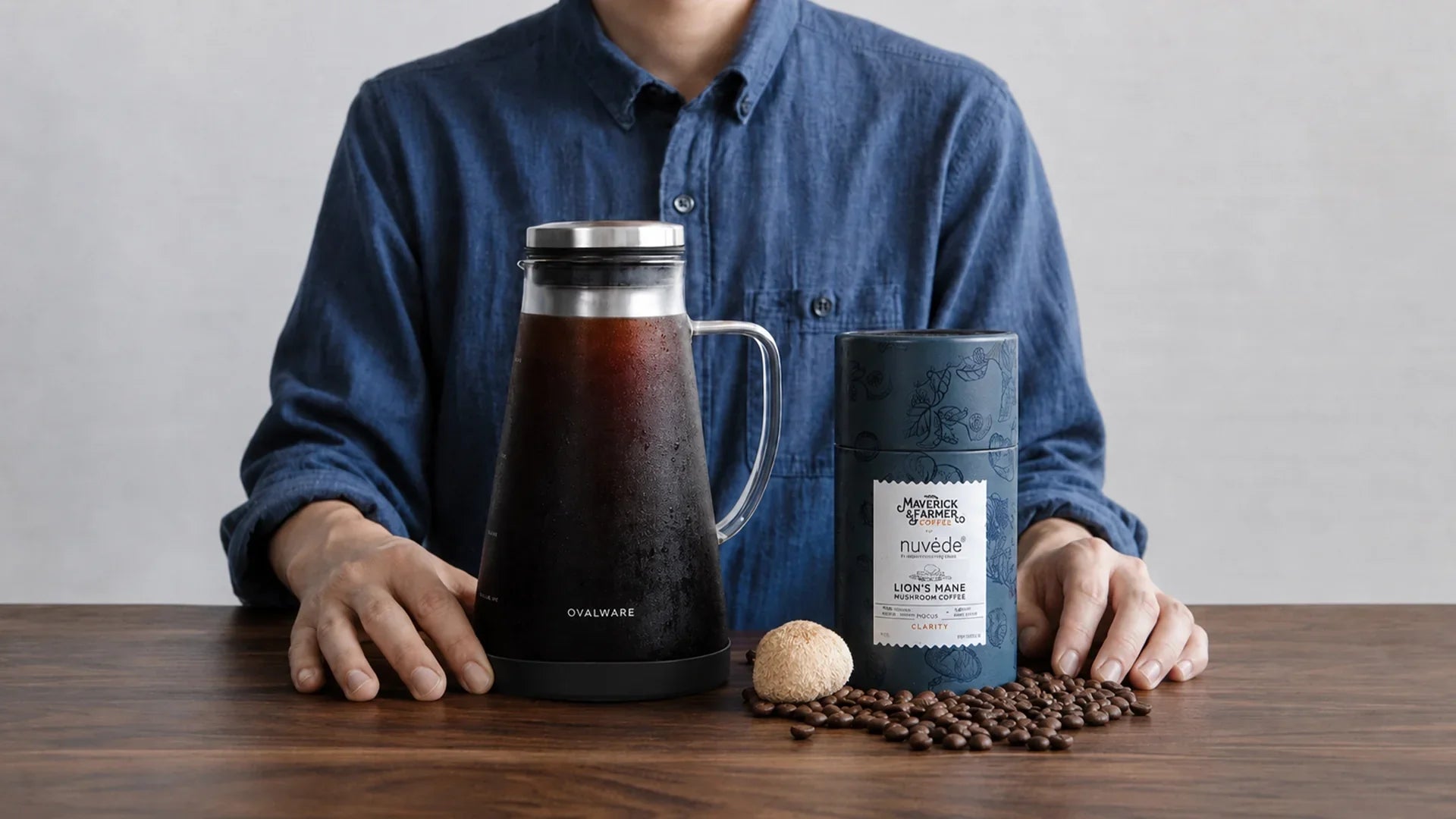
The Ovalware Cold Brew Maker makes this straightforward. It uses a borosilicate glass carafe and a stainless steel fine-mesh filter to brew smooth, ready-to-drink cold brew. No concentrate. No dilution needed. Just good coffee straight from the carafe.
What You Need
- Ovalware Cold Brew Maker (1.0L or 1.5L)
- Coarsely ground coffee (see grind size guide)
- 1 to 2 teaspoons of mushroom powder or extract (lion's mane and chaga work particularly well)
- Cold filtered water
The Process
- Measure your coffee. For the 1.0L maker, use about 85g of coarsely ground coffee per 1L of water (roughly a 1:12 ratio). For the 1.5L maker, use about 110g per 1.5L water (roughly 1:14). Read more about steep times and ratios.
- Add the mushroom powder. Mix 1 to 2 teaspoons of mushroom extract powder directly into your ground coffee. Lion's mane blends in almost invisibly. Chaga adds a subtle earthiness that works nicely with coffee's natural bitterness.
- Fill with cold water. Pour cold filtered water over the coffee and mushroom blend. Make sure all the grounds are saturated.
- Steep in the fridge. Seal the carafe and steep in the refrigerator for 12 to 18 hours. If you're steeping at room temperature, 8 to 12 hours is enough.
- Remove the filter and serve. Pull the filter out, and your cold brew is ready to drink. No dilution needed. Serve over ice or straight from the carafe.
The cold brew carafe doubles as a serving vessel, which keeps the morning routine simple. Pair it with the Ovalware Double Wall Tasting Glass to keep your brew cold without dilution from ice melt.
If you want to go further with cold brew variations, check out the plastic-free coffee maker guide or the protein coffee recipe for more ways to build functional coffee at home.
Ovalware Cold Brew Maker
| Size | Price | Coffee Ratio | Best For |
|---|---|---|---|
| 1.0L / 34oz | $40.99 | ~85g coffee per 1L water (1:12) | 1 to 2 people, daily use |
| 1.5L / 51oz | $46.99 | ~110g coffee per 1.5L water (1:14) | 2 to 4 people, weekly batch |
Shop the Ovalware Cold Brew Maker , free shipping on US orders $65 or more.
Is Mushroom Coffee Worth Trying?
Honest answer: it depends on what you want from it.
If you're looking for a dramatic health transformation, mushroom coffee is probably not the right expectation to set. The research is real but early, and the doses in commercial products are often lower than what studies used.
If you're looking for a slightly lower-caffeine coffee option, a new morning ritual, or a simple way to get more antioxidants and potentially some adaptogen support, mushroom coffee is a reasonable, low-risk experiment. Most people who enjoy it do so because it makes them feel good and fits their routine, not because they've run a personal clinical trial.
Making your own version at home using a quality cold brew setup and a reputable mushroom powder gives you the most control. You know exactly what's in it, at what dose, and you're not paying a markup for a pre-packaged blend. For most people, that's the smartest way to start.
FAQ
Does mushroom coffee actually work?
Some of the individual compounds in medicinal mushrooms have shown real effects in research settings. Lion's mane has the most promising evidence for cognitive support, and turkey tail has the most robust research overall. But whether the amounts in a coffee blend are enough to produce those effects is unclear. Think of it as a supportive addition to a healthy routine, not a standalone cure.
What does mushroom coffee taste like?
Most mushroom coffees taste primarily like coffee. The mushroom flavor is subtle, usually a slight earthiness or nuttiness depending on the blend. Chaga tends to add the most noticeable flavor. Lion's mane is almost neutral. Reishi can be slightly bitter. If you make your own blend, you can adjust the ratio to match your taste.
Is mushroom coffee safe?
For most healthy adults, mushroom coffee is considered safe at typical doses. Medicinal mushrooms have a long history of use in traditional medicine with a good safety record. Some people with mushroom allergies or autoimmune conditions should check with a doctor before adding mushroom supplements to their routine. As with any supplement, sourcing from a reputable brand matters.
How much caffeine is in mushroom coffee?
It varies by product. Many commercial mushroom coffees contain roughly 50 to 75mg of caffeine per serving, compared to 95 to 150mg in a typical cup of drip coffee. Some products are fully caffeine-free, using only mushroom powder with no coffee at all. Check the label of whichever product you choose for exact amounts.
Can you make mushroom cold brew at home?
Yes, and it's one of the easiest ways to try mushroom coffee. Add 1 to 2 teaspoons of mushroom powder (lion's mane or chaga are good starting points) to your ground coffee before brewing. Use a cold brew maker like the Ovalware Cold Brew Maker, steep for 12 to 18 hours in the fridge, and you'll have a smooth, ready-to-drink batch that lasts up to two weeks.