Pour Over Grind Size: The Exact Setting for a Clear, Balanced Cup
Grind size is the variable that makes or breaks pour over coffee. Change it by one or two clicks on your grinder and the brew time, extraction rate, and final flavor all shift noticeably. Too coarse and water races through the grounds before it can dissolve the good stuff , you get a weak, sour, hollow cup. Too fine and the bed chokes, water pools on top, and bitterness takes over.
Most guides tell you "medium-fine" and call it done. But the right pour over grind size depends on one thing most guides don't address: the filter you're using. And if you're using an Ovalware stainless steel filter , either the one built into the Pour Over Maker or the standalone cone filter , the recommendation shifts because of a specific design difference that no generic guide covers. Here's what that difference is, and how to use it.
Why Grind Size Controls Everything in Pour Over
Pour over extraction happens in a 2.5-4 minute window. In that time, water has to move through the coffee bed, dissolve the right compounds in the right proportions, and drain cleanly. Grind size determines how quickly all of that happens.
Coarser grounds have more space between particles. Water moves faster, contact time is shorter, and extraction is lower , pulling fewer compounds, often leaving the natural sugars under-dissolved and the cup tasting sour or thin. Finer grounds pack tighter. Water slows, contact time increases, and extraction rises , but push it too far and the harsh, bitter compounds get pulled too, overwhelming the sweetness and acidity that make great pour over distinctive.
The Honest Coffee Guide's grind size chart describes the ideal pour over range as medium-fine , roughly the texture of fine table salt or fine beach sand. Trade Coffee's grind guide agrees: pour over sits between espresso (very fine, almost powdery) and French press (coarse, granular), with the exact point shifting based on your setup. Your target brew window, per the 1Zpresso dial-in guide, is 2.5-3.5 minutes total from first pour to last drip. That window is your grind size feedback system.
The pour over ratio guide covers the coffee-to-water ratio side of this equation , because grind size and ratio work together. If you're already dialed in on ratio but your cup tastes off, grind size is usually the culprit.

The Dual-Layer Filter Design: Why It Changes the Equation
Most affordable stainless steel pour over filters use a single mesh layer. Water flows through one plane of tiny holes, and because no second layer catches finer particles, the grind you use has to account for the filter's limitations. If you go too fine, particles seep through into your cup, making it gritty and muddy. This forces you to grind coarser than ideal , which can leave extraction under-developed and your cup thinner and less sweet than it should be.
Ovalware's stainless steel filters use a dual-layer construction. The outer layer is laser-cut stainless steel , precision-cut holes provide structural support and pre-filtration, catching the larger particles and giving the filter its shape. Inside that sits an ultra-fine mesh inner layer that handles actual filtration , trapping the fine particles that make it through the outer layer. These two layers work together to catch significantly more than a single-mesh filter can at the same grind setting.
What this means in practice: you can grind slightly finer with an Ovalware filter than with a single-mesh alternative, because the inner mesh compensates for what would otherwise seep through into your cup. This lets you extract more completely at a given grind setting , improving sweetness, body, and overall cup clarity , without introducing muddy sediment. It's a meaningful practical difference. And because no generic pour over guide is written with a dual-layer stainless filter in mind, the standard "medium-fine" recommendation for paper filters doesn't fully capture what this filter can do.
The Ovalware stainless steel vs paper filter guide goes deeper into how each filter type affects your cup's flavor, body, and the oils that come through.
Recommended Grind Size for Each Ovalware Filter
There are two Ovalware products with stainless steel filters. They have the same dual-layer construction but slightly different grind recommendations based on how they're used.
| Product | Filter Construction | Recommended Grind | Why |
|---|---|---|---|
| Pour Over Maker (built-in filter, $46.99) | Dual-layer: laser-cut outer + ultra-fine mesh inner | Medium-fine | Calibrated specifically for this brewing system; inner mesh handles fine particles cleanly at this setting |
| Standalone Stainless Steel Filters ($27.99) | Dual-layer: laser-cut outer + ultra-fine mesh inner | Medium | Fits a range of cone brewers with different geometry; medium is the safe, reliable starting point across setups |
Pour Over Maker (Built-In Filter) , Medium-Fine
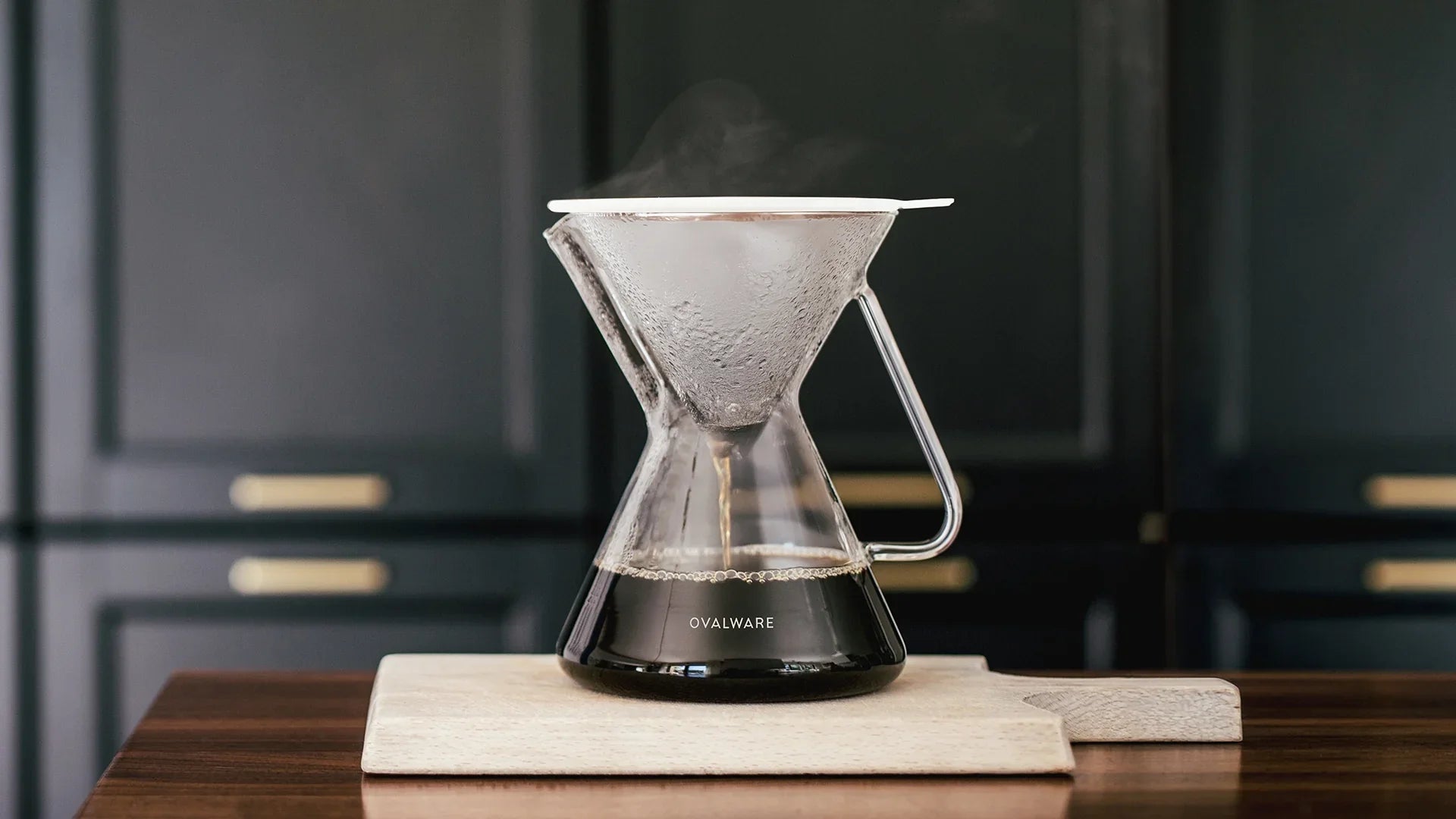
The Ovalware Pour Over Maker is a 3-piece kit , borosilicate glass carafe, dual-layer stainless steel filter, and lid. The filter is specifically designed and calibrated for this brewing system. At medium-fine, the inner mesh catches fine particles cleanly, drawdown stays in the 3-3.5 minute target window for a 500ml brew, and you get a cup with clarity, natural sweetness, and satisfying body. Medium-fine here looks and feels like fine beach sand , distinct particles you can see, with some texture between your fingers.
Standalone Stainless Steel Filters , Medium
The standalone Ovalware Stainless Steel Filters ($27.99, available in Silver, Gold, Rose Gold, and Aura Silver) fit cone-style pour over brewers , V60-style drippers, open-cone setups, and similar designs. Because cone geometry varies between brewers and affects how quickly water drains, medium is the recommended starting grind. At medium, you have headroom to go slightly finer if the brew runs too fast, or coarser if it stalls. Note: very fine grounds may seep through even the dual-layer filter in some dripper geometries, so avoid going finer than medium-fine with the standalone filters. These filters are designed for pour over only , not cold brew, French press, or drip machines.
How to Dial In Your Pour Over Grind
Starting at the recommended grind is your baseline. From there, dial in based on brew time and taste. This process takes 2-3 brews and is the fastest way to lock in a reliable, repeatable cup.

Step-by-Step Dial-In
- Set your grinder to medium-fine (built-in filter) or medium (standalone filters).
- Brew a standard batch: 15g coffee to 250ml water at 93°C (200°F). Start your timer.
- Track drawdown time. Your total brew should finish in 2.5-3.5 minutes from first pour. Under 2 minutes: go finer. Over 4 minutes or the bed stalls: go coarser.
- Taste and adjust. Sour, thin, and hollow? Go finer. Bitter, harsh, dry finish? Go coarser. Balanced, sweet, and clean? Lock in that setting.
- Change one variable at a time. Adjust grind by 1-2 clicks. Brew again. Repeat until the cup is where you want it.
The Basic Barista's pour over grind guide calls brew time "the most reliable real-time feedback for grind size" , which is accurate. Your taste buds confirm the outcome; the clock explains why. Use both.
Troubleshooting: What Your Cup Is Telling You
| What You're Tasting | What's Happening | Fix |
|---|---|---|
| Sour, thin, watery | Under-extracted , water moved too fast | Go finer by 1-2 clicks |
| Bitter, harsh, dry finish | Over-extracted , water moved too slowly | Go coarser by 1-2 clicks |
| Muddy, gritty texture | Fines seeping through the filter | Go coarser; check grinder for burr wear |
| Flat, no brightness or sweetness | Under-extracted or stale beans | Go slightly finer; check bean freshness |
| Balanced, sweet, clean, with some brightness | Correct extraction | Lock in that grind setting |
Other Variables That Work With Grind Size
Grind size doesn't operate alone. These variables interact with it and affect your extraction , knowing how they relate helps you make smarter adjustments.
Water Temperature
92-96°C (198-205°F) is the standard pour over range. Hotter water extracts faster and more aggressively , if your temperature is at the high end, you may want to grind slightly coarser to keep extraction in check. Cooler water extracts more slowly and may require a slightly finer grind. My Home Barista's grind guide covers the temperature-grind interaction in useful detail.
Pour Technique
Aggressive pours with high agitation extract faster. Slow, gentle spiraling pours extend contact time. Coffeeness's extraction chart notes that pour style can shift your effective extraction by the equivalent of half a grind setting , which is why consistent technique helps you dial in your grind more accurately. If you're pouring differently every morning, you're also changing your extraction every morning.
Coffee Freshness
Freshly roasted coffee (within 2-4 weeks of roast date) has more CO2, which creates resistance during brewing and effectively slows water flow. Older coffee is denser and brews faster at the same grind. If you've just opened a very fresh bag, grind slightly coarser. If the bag is 6+ weeks past roast, try slightly finer. Batch Coffee's pour over grind guide covers how freshness changes extraction behavior.
Stainless Steel Filters vs Paper Filters: Does It Affect Grind Size?
Yes , and this point is underappreciated. Paper filters trap most of the coffee's natural oils and all fine particles. They also restrict flow, slowing drawdown and extending brew time. Stainless steel filters let oils through (which adds body and richness to the cup) and drain faster at the same grind size.
This means if you're switching from paper to an Ovalware stainless steel filter, you'll likely need to go slightly coarser to hit the same brew time. Your cup will also have more body and mouthfeel , that's the natural coffee oils coming through, and it's one of the reasons many specialty coffee drinkers prefer stainless over paper.
For a full comparison of what each filter type does to flavor, body, and oils in the cup, the stainless steel vs paper filter guide covers everything. And if you're curious how pour over compares to cold brew as a method overall, see the cold brew vs pour over breakdown.
The standalone Ovalware Stainless Steel Filters are also reusable indefinitely with proper care , rinse with warm water after each use, top-rack dishwasher safe, and a white vinegar soak for deep cleaning when oils build up. No replacement filters, no paper waste. If you're after a plastic-free, paper-free pour over setup, the glass carafe plus stainless filter combination is one of the cleanest brewing setups you can build.
The 2026 World Brewers Cup competitors , brewing at the highest level of pour over competition , consistently use precisely calibrated grind settings and high-quality filter setups to extract clean, balanced cups. As covered in the World Brewers Cup 2026 pour over guide, the principles they use are the same ones that make home pour over better: controlled grind, consistent pour, quality filter.
Your Pour Over Setup at a Glance
| Pour Over Maker (with Filter) | Standalone Stainless Steel Filters | |
|---|---|---|
| Price | $46.99 | $27.99 |
| Includes | Borosilicate glass carafe + dual-layer filter + lid | Dual-layer filter (fits cone-style brewers) |
| Filter construction | Laser-cut outer + ultra-fine mesh inner | Laser-cut outer + ultra-fine mesh inner |
| Finishes | N/A (glass carafe) | Silver, Gold, Rose Gold, Aura Silver |
| Recommended grind | Medium-fine | Medium (start here, adjust based on dripper) |
| For use with | Complete brewing system | Cone-style pour over brewers only |
| Free shipping | US orders $65+ | |
Frequently Asked Questions
What grind size is best for pour over coffee?
Medium-fine is the standard starting point for most pour over setups, resembling fine table salt in texture. With the Ovalware Pour Over Maker's built-in dual-layer stainless steel filter, medium-fine is the recommended grind. With the standalone Ovalware Stainless Steel Filters used in a cone dripper, start at medium and adjust based on your specific dripper's geometry and how fast it drains.
Can I grind finer with a stainless steel filter than a paper filter?
You can grind slightly finer, yes. Ovalware's dual-layer filter , with a laser-cut outer layer plus an ultra-fine mesh inner layer , catches fine particles that pass through single-mesh alternatives, giving you a bit more leeway. However, grinding very fine (approaching espresso range) will stall the brew and cause the coffee bed to over-extract. Stay within medium to medium-fine for best results.
How do I know if my pour over grind is too coarse or too fine?
Time your brew. A pour over should complete in 2.5-3.5 minutes total. Under 2 minutes means too coarse , go finer. Over 4 minutes, or the bed stalls with water pooling on top, means too fine , go coarser. Taste confirms it: sour and thin equals under-extracted (too coarse); bitter and harsh equals over-extracted (too fine).
What grind size should I use for the Ovalware Stainless Steel Filters?
Start at medium , similar to coarse table salt, slightly finer than French press. The dual-layer construction (laser-cut outer layer for structure and pre-filtration, ultra-fine mesh inner layer for actual filtration) gives more flexibility than single-mesh filters. However, very fine grounds may still seep through in some cone dripper geometries, so avoid grinding finer than medium-fine with the standalone filters.
Are Ovalware stainless steel filters only for pour over?
Yes , both the built-in filter in the Pour Over Maker and the standalone Stainless Steel Filters are designed for cone-style pour over brewing only. They are not compatible with cold brew, French press, or drip machines. The standalone filters are available in four finishes: Silver, Gold, Rose Gold, and Aura Silver, and fit most standard cone-style pour over drippers.
The Key Takeaway
Most pour over guides treat grind size as a single universal setting. It isn't , and the filter you use is the variable they're missing. Ovalware's dual-layer stainless steel construction gives you more extraction precision than a basic single-mesh filter at the same grind setting, because the inner mesh catches what the outer layer doesn't.
Start at medium-fine with the built-in filter on the Pour Over Maker. Start at medium with the standalone Stainless Steel Filters. Time your brew. Taste it. Adjust one click at a time. Within 2-3 brews, you'll have it dialed , and from there, the Ovalware filter lets you brew a consistently clear, balanced cup with no paper waste, no complicated cleanup, and no replacement costs ever.
Get the Ovalware Pour Over Maker with filter or the standalone Stainless Steel Filters for your existing cone dripper , both available at ovalware.com.